The Final 42

(This story originally appeared in the Monument Park Commemorative Edition of Yankees Magazine. To purchase your copy, visit www.yankees.com/publications or call 800-GO-YANKS.)

I’ve always been of two minds about the idea of retiring uniform numbers. On the one hand, I certainly understand the sentiment — it’s a recognized means of appreciating greatness, and I’m on board with that. The downside to me, though, is that in doing so, your taking away the opportunity for players to recognize their heroes by choosing to wear the number. When Carlos Delgado wears 21 to celebrate Roberto Clemente, that’s obviously a meaningful tribute; does it really make sense that a player for the Pittsburgh Pirates can’t make the same choice?

I’m pretty sure that I’m in the minority on this, so I don’t feel any real need to harp on it. I kind of liked it a few years back when the University of Michigan — my alma mater — began honoring greats from the team’s past by “unretiring” their numbers. Essentially, they tried to establish the idea of wearing those numbers as a privilege, rather than celebrating the university legends by keeping their numbers out of rotation. I liked seeing Michigan QB Devin Gardner wearing 98, as a tribute to “Old 98” Tom Harmon. But again, your mileage may vary.

Embed from Getty Images

Anyway, that’s a long lead-in to this Q&A with Sharon Robinson, daughter to the legendary American pioneer Jackie. In 1997, on the 50th anniversary of his big-league debut, Major League Baseball retired Jackie’s No. 42 throughout the league, while grandfathering in the right for players already wearing the number to keep it until they retired. Mariano Rivera eventually became the last player in the league wearing the hallowed digits, even as it already hung in Monument Park, as it did at the other 29 Major League stadiums.

When Rivera finally retired after the 2013 season, the number went with him. Now it only appears every April 15, during the league-wide celebration of Jackie Robinson Day, at which all players on all 30 teams wear Jackie’s 42.

I think Sharon is a terrific person to speak with — I’ve long admired the way she honors her parents’ legacy by her work in educating children about the era in which her father played, and the struggles that continue. I thought a lot of her answers about Jackie’s legacy — and especially about Jackie as a father — were exceptionally interesting.

https://www.mlb.com/yankees/news/sharon-robinson-qa/c-263620308?tid=163658034

The Showman

(This story originally appeared in the Oct. 2017 edition of Yankees Magazine).

This one didn’t have much of a shelf-life. But I still really liked the story, and I enjoyed the process of reporting it.

Over the course of the 2017 season, I noticed that Joe Girardi’s YES Network television show was becoming surprisingly ambitious and interesting. What had once been just a camera on him in the manager’s office, recounting a week that anyone watching already knew all about, had turned into a series of trips around different cities with the show’s co-host, YES Network field reporter Meredith Marakovits. In Seattle, they went to the Starbucks Roastery. They made pizza in Chicago and visited his old dorm at Northwestern.

The trips showed a different side of the Yankees’ manager. Often chided for his reliance on on his binder, or his less-than-comfortable manner in front of the microphone (although I’d argue that over the second half of his Yankees tenure, he’d improved in both facets dramatically), Girardi was playful and engaging throughout the television broadcasts. He seemed, despite the artifice that the cameras necessitated, somewhat … real?

So I got them to allow me to tag along for a trip to the Dallas Cowboys’ sparkly practice facility north of Dallas. It was a quick trip — a night in Texas, total of about 20 hours. But it was great to see the whole shoot, to see how the show came together, to watch him engage with the Cowboys personnel (including head coach Jason Garrett). It was also, I have to say, a lot of fun to get to take the tour (even if it felt like a betrayal of my Giants roots).

I always got along well with Girardi. I think he’s a good man, with a good heart. I’ll never forget the times I got to watch him interact with young kids away from cameras, or the way he wore the shirts for different charities during every pregame presser for a few seasons. It was a remarkably kind gesture, and totally selfless. I doubt that he thought much about me either way, but I really got the sense of Girardi’s decency.

He also, it should be said, had a ton of success in New York, from the World Series championship in 2009, to the awesome performance by his 2017 group, that would end up a game shy of the World Series.

So, to put it mildly, there were a host of reasons I felt bad to see him let go once the team was eliminated, not the least of them being the fact that it made my feature about him in that month’s magazine look somewhat silly. But oh well. I still enjoyed the process, enjoyed the story, and enjoyed my four years working with Girardi.

https://www.mlb.com/yankees/news/yankees-manager-joe-girardi-show/c-258700434

Spreading The News

(This story originally ran in the September 2017 edition of Yankees Magazine).

Stories come from different places. Sometimes I’ll be watching a game and see something happen, and it will make me want to examine it further. Sometimes I’ll talk to a player in the clubhouse and find him incredibly interesting, making me want to have more and more conversations with him. Sometimes you just write what you’re assigned.

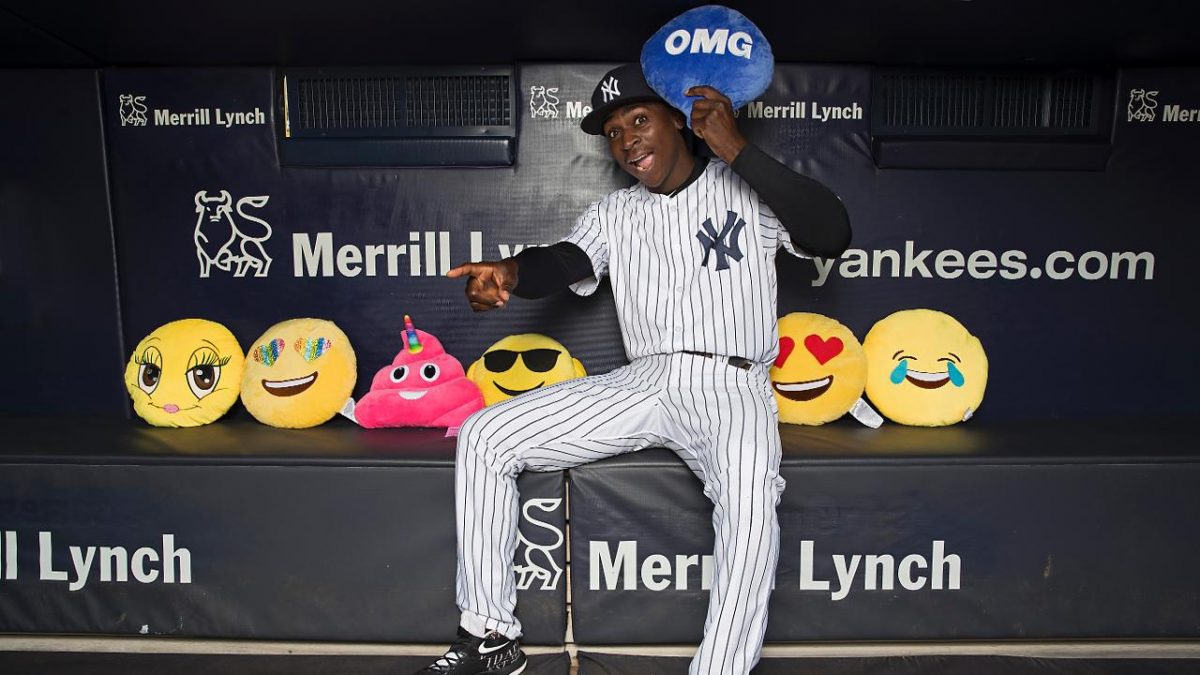
With this Didi Gregorius feature, though, my idea wasn’t for a story; it was for a photo shoot. I desperately wanted to organize a photo shoot of Didi engaging with various types of emoji.

Some background: after every Yankees win since the beginning of 2017, Gregorius has tweeted out a recap of the game rife with emoji, with different marks for each player. The tweets are whimsical and fun, but they drove reporters into a frenzy to try to figure out what each one meant, and Didi refused to say.

So I went on Amazon and bought a ton of different emoji paraphernalia — balloons, pillows, beach balls, etc — and put together a story about the whole phenomenon. In the process, I spoke with linguists who tried to explain to me how different brains might respond in different ways to the emoji; might it make sense that Gregorius, who famously speaks a handful of different languages, might have an easy way with the emoji keyboard?

Either way, I loved writing about the Yankees’ Rosetta Stone, and I hope you’ll enjoy the feature.

https://www.mlb.com/yankees/news/didi-gregorius-is-a-fan-favorite-in-new-york/c-253188212