Small Ball, Big Time

(Story originally appeared in the March 2017 edition of Yankees Magazine.)

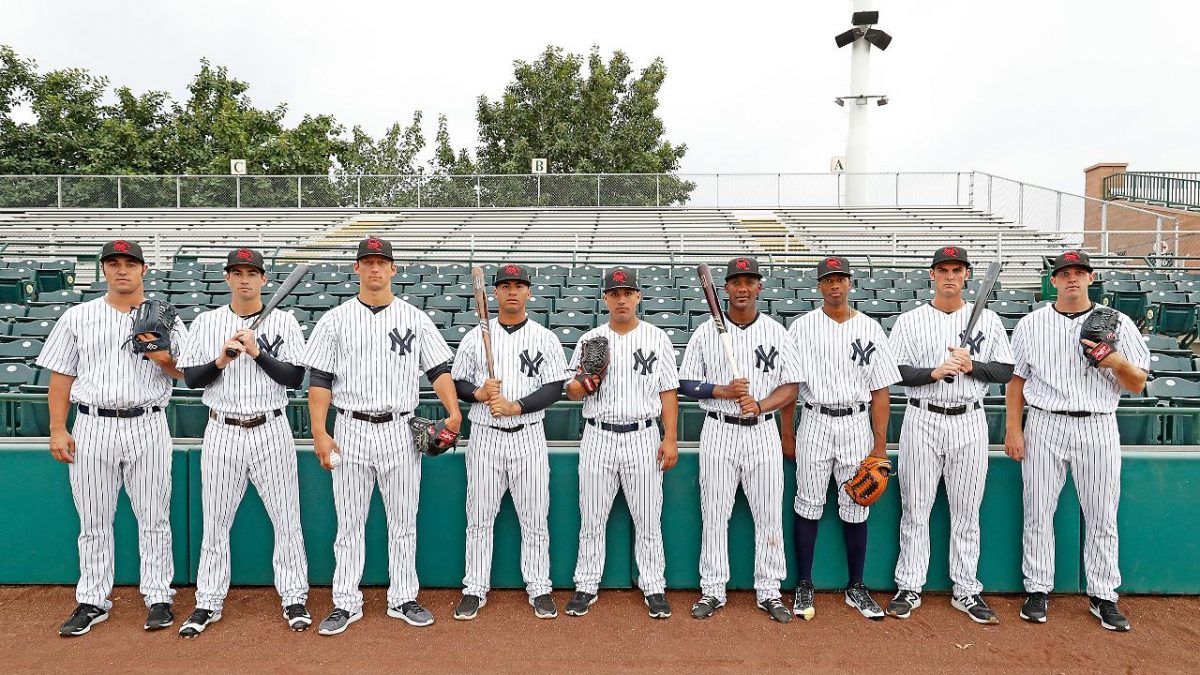
I had always wanted to see what the Arizona Fall League was like, and I picked a good year to do it. The Yankees sent a pretty remarkable contingent out west to play for the Scottsdale Scorpions, and I had a great time getting to see some of the top prospects in the organization. Plus, I also got to witness the Tim Tebow mania for the first time, which was a sight to see.

The headliner of the group was obviously Gleyber Torres (more on him in a future post), but there was talent all around. Greg Bird, James Kaprielian, Tyler Wade, J.P. Feyereisen, Dillon Tate, Miguel Andujar, Brody Koerner, Nestor Cortes … it was really great squad, with plenty for fans to get excited about. But mostly, I just enjoyed how free and open the Fall League is. We really had the full run of the place, hanging out on the field and doing whatever we wanted while the players were working out. I feel like I could have grabbed a bat and taken some swings if I had wanted to.

I hope I can get back there again sometime, maybe for a bit longer, but it was definitely a good first experience. It really made me miss getting to go to Cactus League games.

Here’s the story. Hope you’ll enjoy.

http://m.mlb.com/news/article/215898390/arizona-fall-league-top-yankees-prospects/

Legends Never Die

(Story originally appeared in the Home Run Commemorative Edition of Yankees Magazine.)

Weird confession here: Until I decided to write this story, I had somehow never seen The Sandlot. I don’t know how I had avoided it through the years, but it just never happened. But as I describe in the opening scene in the story (which was a pretty accurate chronology of my reporting), I didn’t have any choice once I started talking to some of the players about their first contact with the legend of Babe Ruth.

We were producing a special edition of Yankees Magazine that was celebrating home runs and home run hitters in Yankees history. I decided to write a story about the Babe Ruth Birthplace & Museum in Baltimore, and I was extremely fortunate to have the museum’s curator, Michael Gibbons, take me around the exhibits, then drive me and a photographer all over the Babe’s Baltimore, showing me other places he lived, the boarding school where he was discovered, and other places from his life. As I detail in the story, though, I didn’t end that day with any clear picture of what I wanted to write. Something about spending time around all these places from Ruth’s past made him smaller, in a way; it was diminishing. That’s not a knock on the museum at all — it does a wonderful job showing Ruth the human. But it’s hard to square that circle with the image of Ruth the superhero.

Confused as to how I should proceed, I posed the question to a bunch of players on the team — what was their first contact with the legend of the Babe. How did their shared experience of being Yankees color their perspectives. I was hoping that the players could help me bridge the gap that separated who I felt Ruth was, and how he was perceived. But the first three players I spoke to — Andrew Miller, Chase Headley and Aaron Hicks, literally the first three players! — all mentioned the same thing: The Sandlot. 

Well, I guess I had to watch the movie.

And it was great, of course. I reached out to the writer and director, David Mickey Evans, to see if maybe he could help me answer the question better. And then the inspiration hit, and the words started flowing. I’m really proud of this story, as I think it does a good job looking at the way that we create heroes, and the people that they really are. As the

We discuss this a lot more on this episode of the Yankees Magazine Podcast. Take a listen (and subscribe!).

Anyhow, enjoy the story.

http://m.mlb.com/news/article/209340058/legend-of-babe-ruth-lives-on/

Confidence Man

(Story originally appeared in the Derek Jeter Commemorative Edition of Yankees Magazine)

When Derek Jeter announced his retirement before the 2014 season, we knew that we needed to do something extra special to celebrate his career, so we put together a special edition of the magazine, looking back on the Captain’s entire career. It was an awesome project, with so much awesome material that we were able to unearth. We reran a bunch of old Yankees Magazine content and supplemented it with some great original pieces.

Obviously, there are only so many different ways to talk about Jeter on the field, particularly when you’re a house organ like Yankees Magazine. So it was really important to me that I find something a bit off-beat. I had always been intrigued by the story of Dick Groch, the scout who signed Jeter. The main is famous — trying to alleviate the concern in the Yankees’ war room that they were going to use the 6th pick in the Draft on a player who would spurn them to go play college ball at Michigan, Groch, the legend has it, insisted:

“He’s not going to the University of Michigan. The only place Derek Jeter is going is Cooperstown.”

That’s a lot of confidence, and as Groch says in the article, if he had been wrong, he probably wouldn’t have lasted much longer in the industry. But the belief paid off. Jeter became a generational player, a certain Hall of Famer and one of the most beloved Yankees of all time. Not a bad scouting job.

Here’s my attempt at putting Groch’s whole story together. Hope you’ll enjoy.

http://m.mlb.com/news/article/229038088/dick-groch-scouted-jeter-for-cooperstown-in-92/

On the Outside Looking In

(Story originally appeared in the October 2016 edition of Yankees Magazine)

This piece was almost a full year in the making, with any number of starts and stops along the way. It began in Denver, when Greg Bird agreed to let me and a video crew tag along with him for part of his offseason routine. We went to a clinic where he spoke to high school and college coaches, then we went to breakfast with his family and watched him work out the next morning — doing weights and hitting. After that, a few of his high school buddies joined us for an evening at Top Golf in Denver.

It was a pretty awesome time to be Greg Bird. He’d debuted the previous year, and had set New York ablaze with his immediate impact. He even started the team’s postseason game. But about two weeks after we parted ways in Denver, the word came out — Bird would be out for the season, forced to have his shoulder surgically repaired.

I was lucky that I didn’t have to publish the story immediately — honestly, I have no clue what I would have written. So I checked in with him a few times, then met him in Tampa in August to watch his rehab routine. Along the way, Greg couldn’t have been more accommodating. He really opened up about the mental strain of rehab — the way he couldn’t even bring himself to play video games. He had never not been able to play baseball, and nothing made sense to him for most of the year. When the team came to Tampa to play the Rays, Bird went to visit with his old teammates, but he found it too uncomfortable to stick around.

I really wasn’t used to a big leaguer letting himself be this vulnerable. I spoke with Chad Bohling, who heads the team’s mental conditioning department, and he did a good job walking me through all the hardships involved in what Bird was dealing with.

Anyhow, I did my best to convey what the year was really like. I’m very proud of this one.

http://m.mlb.com/news/article/207435348/greg-bird-new-york-yankees-rebound/

Man at the Top

(Story originally appeared in the September 2016 edition of Yankees Magazine)

Pretty simple one here — Joe Torre talking about the 1996 World Series champs, the moment when he turned from “Clueless Joe” into the guy who would be induced into the Baseball Hall of Fame.

This Q&A was part of our season-long retrospective on the ’96 world champs, so I had a lot of room to play with, and Torre was generous with his time. I had to massage my way into his confidence at the beginning — the first couple of minutes, he really didn’t want to dive too deep into any of my questions. But as time passed, he began to open up, and it definitely got emotional toward the end. There was so much on his mind during that World Series, with his brother in the hospital (another brother had passed away earlier that year), and he had such a total love for and devotion to the players on that team.

Anyway, there’s not too much fresh ground turned over in this one, but I think it ended up being a pretty good conversation. Hope you’ll read it.

http://m.mlb.com/news/article/199114972/joe-torre-recalls-1996-and-yankees-dynasty/

The Future Has Arrived

(Story originally published in the September 2016 edition of Yankees Magazine)

When Yankees general manager Brian Cashman got to show off some new muscles at the 2016 trade deadline, it was a landmark moment for the franchise. The Yankees — and Yankees fans, it was thought — simply wouldn’t accept rebuilding. Would they?

It turns out that they would — as long as Cashman nailed all the deals. And he did that, and more, rebuilding a farm system into one of the league’s best (in the offseason after the rebuild, MLB.com would rank the Yankees’ system the second-best in baseball). The club acquired Gleyber Torres and Clint Frazier as the new organizational cornerstones, but the rest of the players who came over — guys like Justus Sheffield, Ben Heller, J.P. Feyereisen, Dillon Tate, Billy McKinney, and a slew of others, as well — have fans in the Bronx hopeful for the future. Some will arrive sooner than others, but it should be interesting to see develop.

Soon after the deadline, Cashman and his top deputy, Jean Afterman, walked me through all the chaos of the day of the deadline, the way that the last-minute deals went down. I always wanted to get to see how the pieces all moved, how tight things got, what rumors were true. They really gave me the full run-down, and I tried to recreate that in the story.

I hope you’ll enjoy.

http://m.mlb.com/news/article/199119640/yankees-use-trade-deadline-to-rebuild/

The Ties That Bind

Originally published in the July 2016 issue of Yankees Magazine

This was a story that I wanted to write for a long time. When I arrived at the University of Michigan as a freshman in 1999, I was at most a passing college football fan. It just wasn’t something that I grew up with in New Jersey. So for my first game, against Notre Dame, I wasn’t entirely sure what I was walking into. It was the best kind of shock — I loved every second of that game, and I’ve been hooked ever since.

I also walked into a QB controversy that has remained somewhat legendary among football fans. On one side was Tom Brady, a workmanlike QB who could get the job done, but who wasn’t ever going to set the world on fire. The guy holding the clipboard (and therefore, the guy the fans wanted to see) was the hotshot sophomore Drew Henson.

The two split time — Brady would play the first quarter, Henson the second, then, supposedly, coach Lloyd Carr would choose the QB who had done better to play the second half. It was almost always Brady. And obviously, everyone knows what happened later for that guy. Seems he did OK for himself.

The next year, despite an early season injury, Henson was remarkable. He came back against Illinois and saved that game, and then was terrific the rest of the way, as the Wolverines went 9-3 and won the Citrus Bowl. The next year was setting up to be something truly special, but then — after saying he was going to stick around — Henson left to play baseball, taking Yankees owner George Steinbrenner’s money, and breaking every Michigan fan’s heart. It was unforgivable, and most people never forgave him.

Nothing at all came of his baseball career, and when I caught up with him, he was scouting for the Yankees, going around the country to see size up players who were doing considerably better than he ever did.

I pitched him the story — could I join him for a trip, being a fly on the wall as he went about his work. He seemed hesitant, but he agreed, and off I went to St. Louis, where I met up with him, then rode with him to Kansas City the next day. It was an amazing trip — I learned so much about the game, about how every single thing that happens on the field means something, about how many moving parts there are. I watch a lot of baseball, and I think I have a generally good handle on the sport, but I couldn’t believe the way that someone in Henson’s position saw things unfold.

For the story, I tried to combine the two pieces of my history with Drew — the college story and the professional experience. I hope it worked; I was really trying to paint my own obsessions as being pathetic, not in any way to judge him.

I hope you enjoy it.

http://m.mlb.com/news/article/189248494/former-yankees-prospect-drew-henson-now-scout/

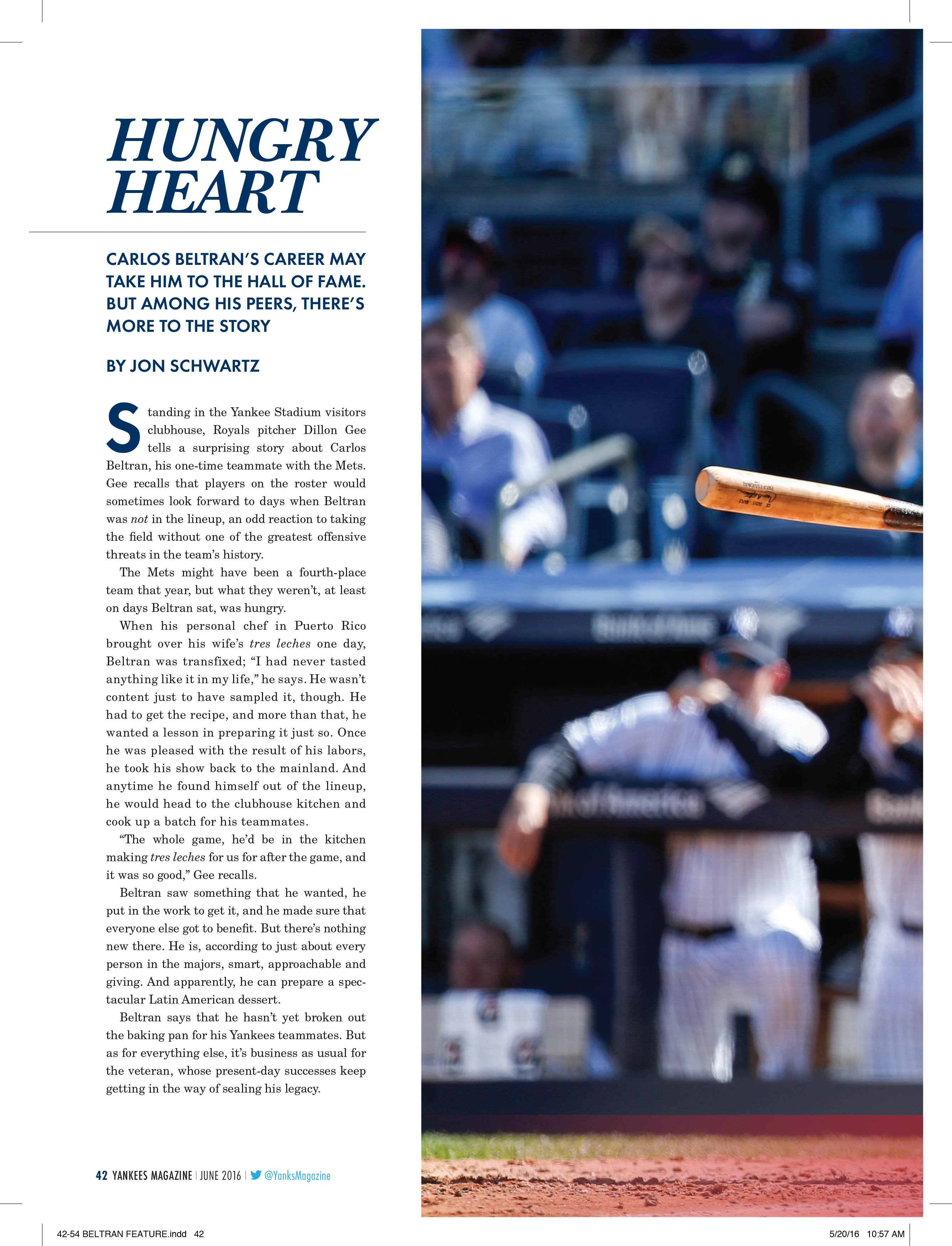
Hungry Heart

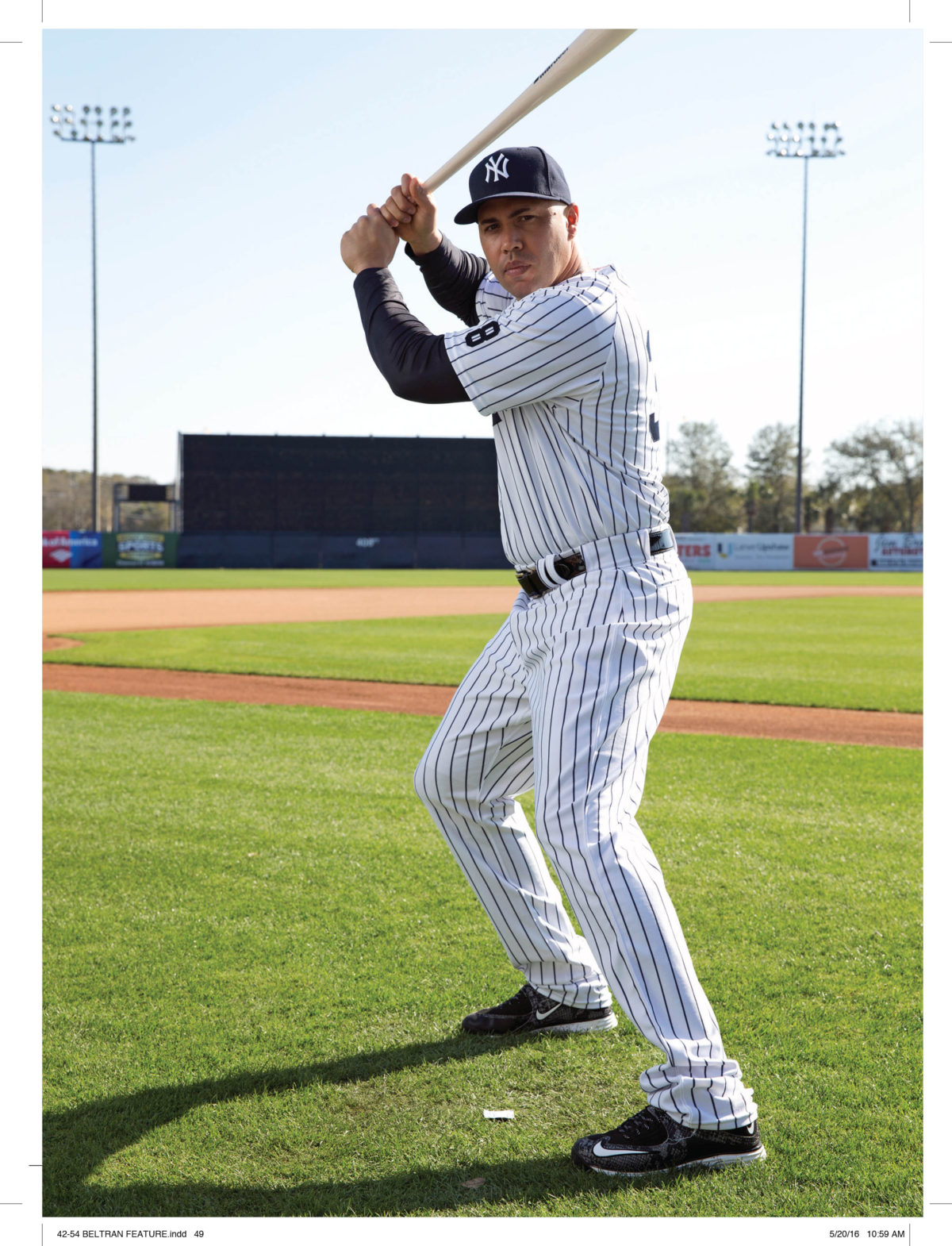
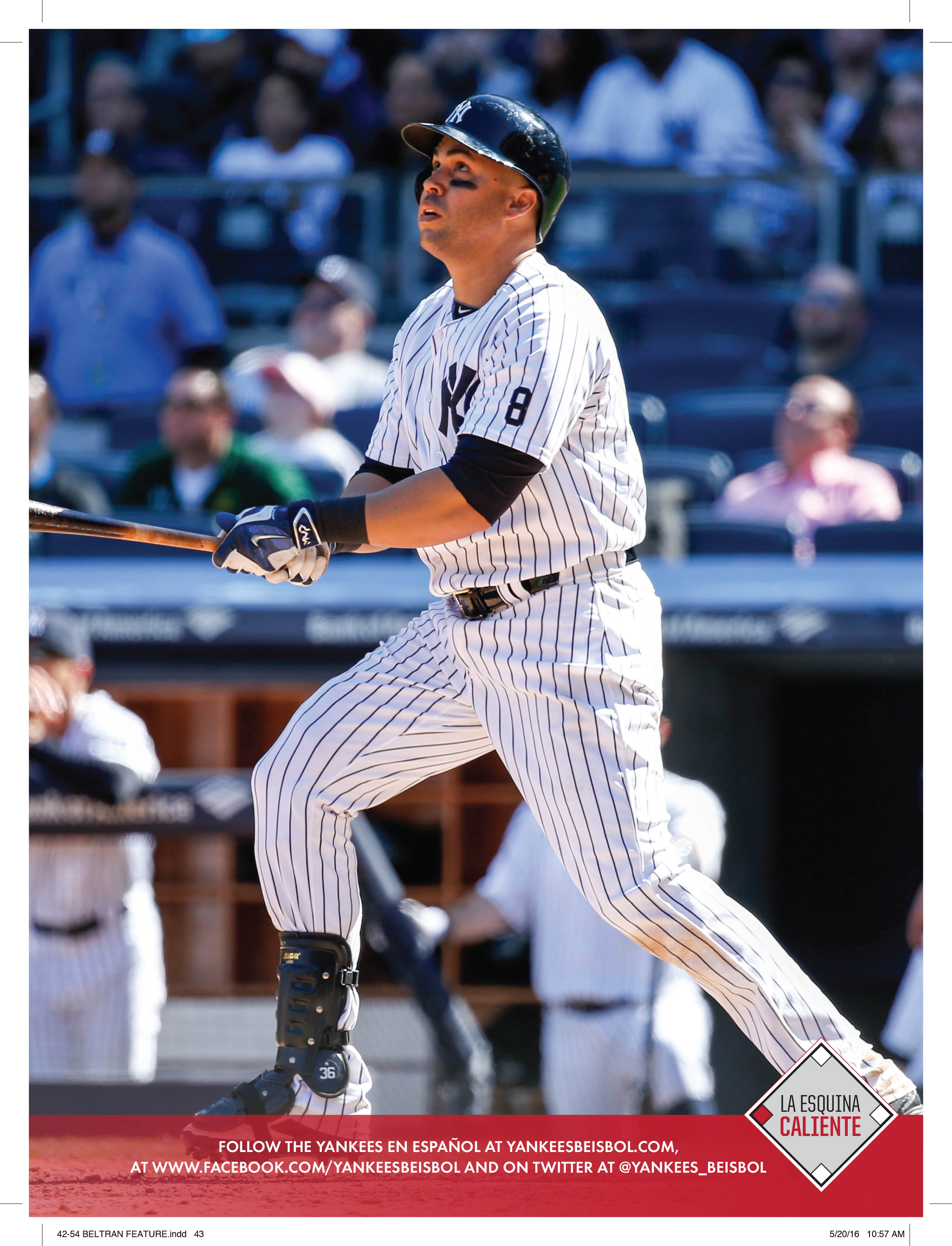
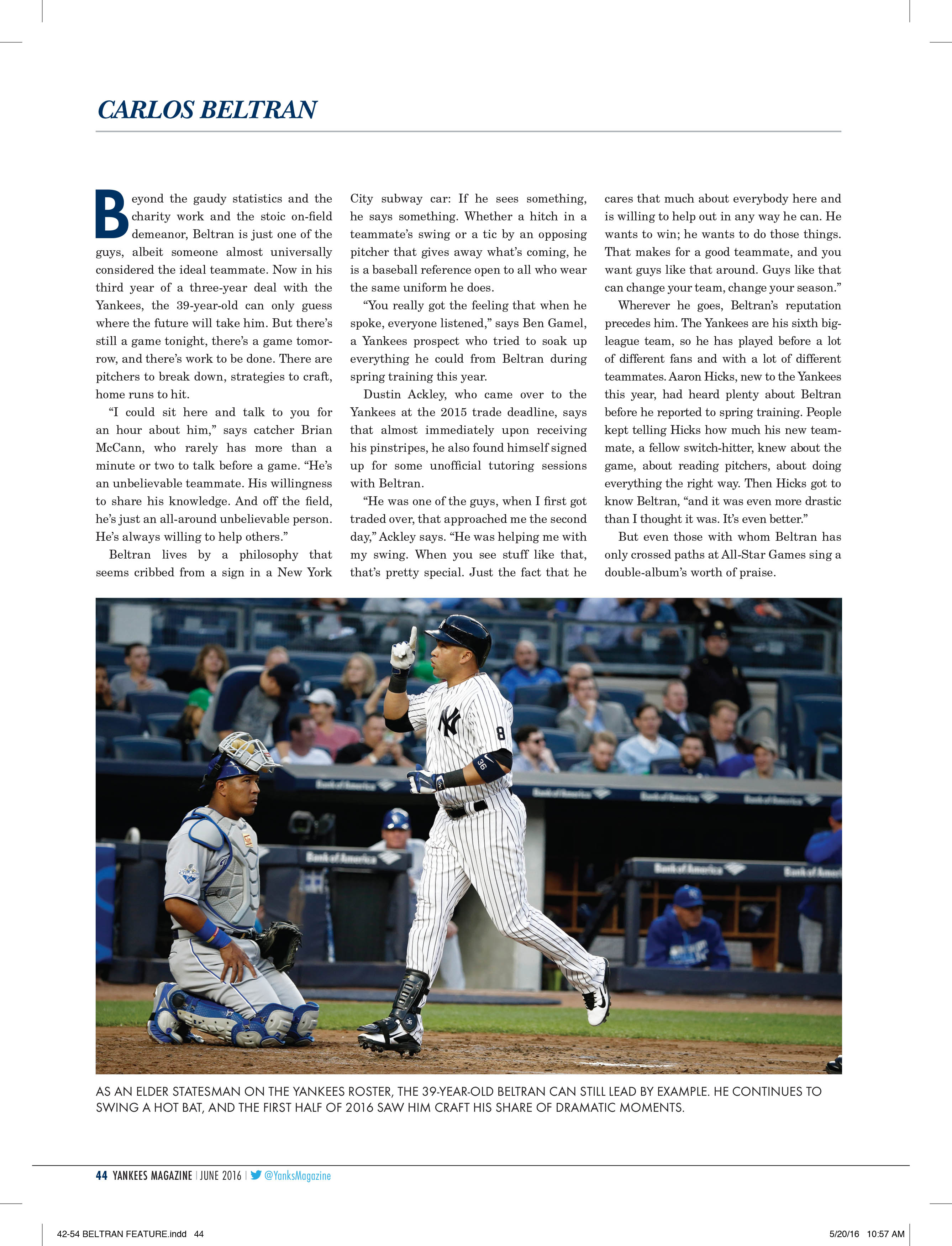
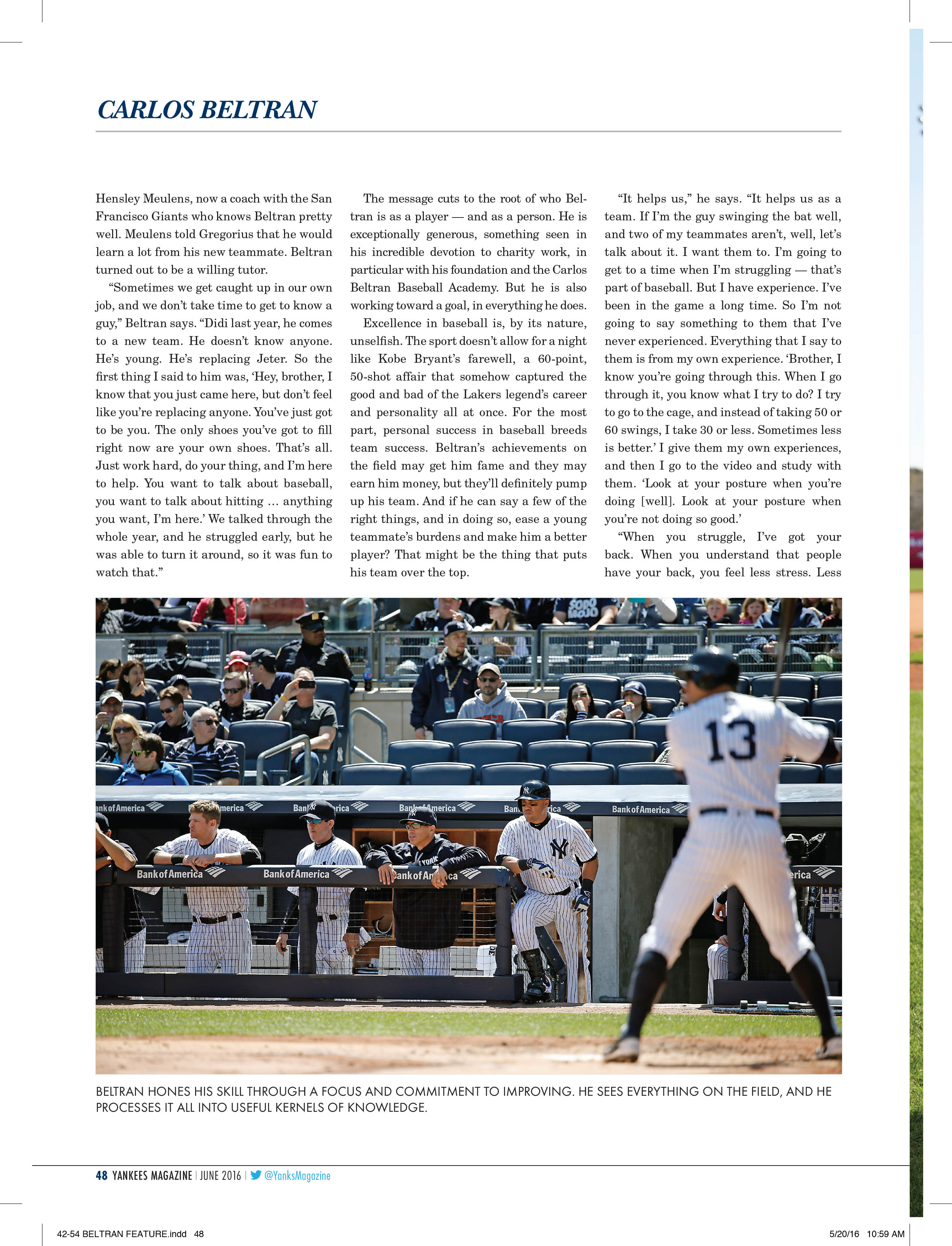
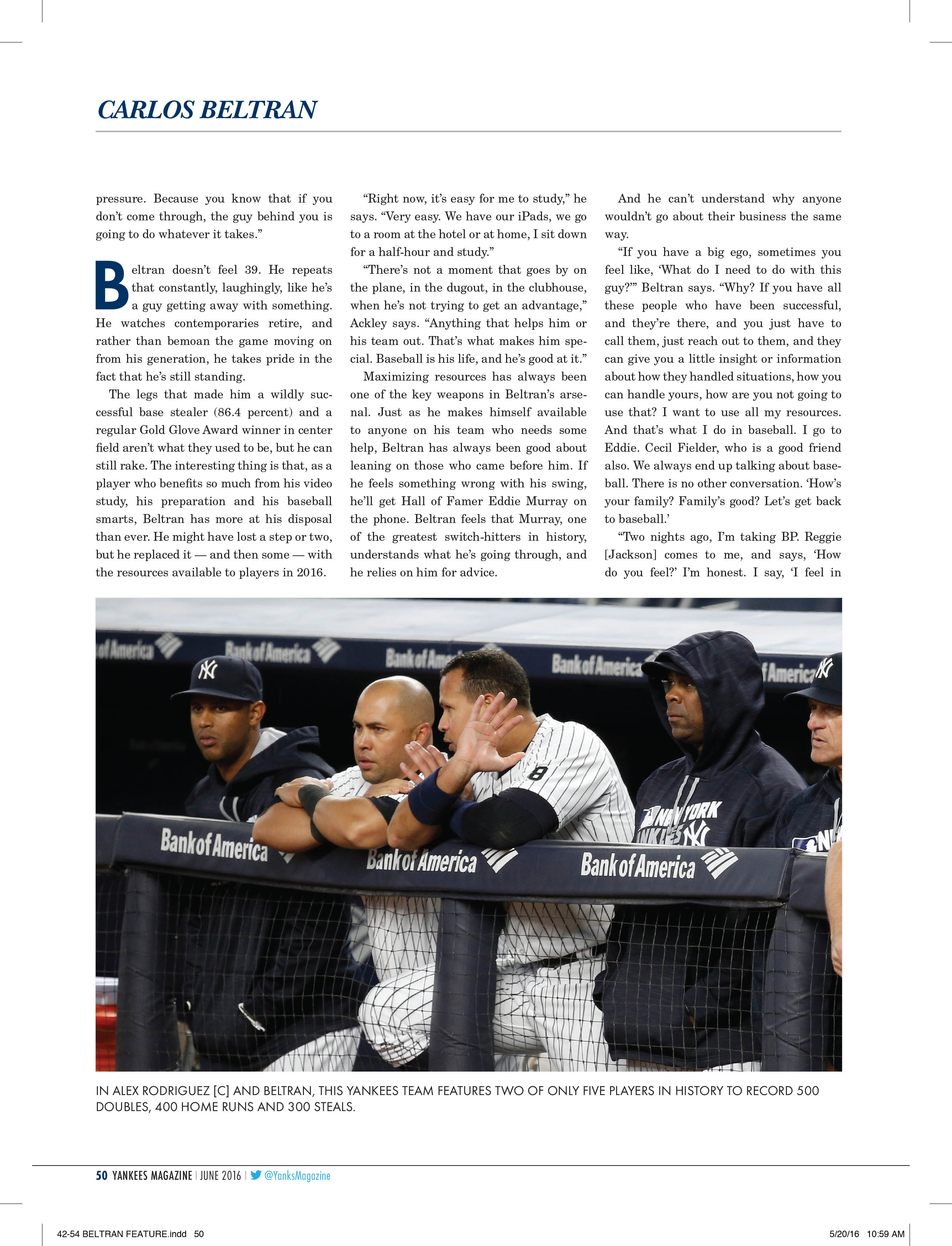
I’ve been covering baseball in one way or another since 2002. In that time, there’s no player I’ve enjoyed working with more than Carlos Beltran, starting when he was on the Mets. Now that he’s playing across town, I’ve had a chance to work really closely with him on a few occasions for Yankees Magazine features. In 2014, I went to his house in Puerto Rico for a story on his rehab from elbow surgery and the baseball academy that he runs on the island. I had a lot of fun reporting that story, and learning about the things that make him so passionate about Puerto Rico and his hometown of Manati.

Since then, I’ve had numerous opportunities to chat with Carlos. He’s such an interesting guy. He is so intelligent about the game, and you can see that in the way he plays. A few days ago, he made a baserunning error, and it was totally galling in a way that it never would have been for anyone else. If there’s one thing you could always say about Carlos Beltran, it was that he had a baseball IQ that was off the charts.

But from experience, I’ve found that whenever I have interviewed a Yankees player, if we start talking about guys who have helped them, almost without fail they mentioned Beltran. One guy after another. He would work in the cage with them. He would help them watch video. He would just point out this or that. I realized, as his three-year contract with the Yankees nears its end, that I wanted to look at the way that players around the league perceive them, and what it says about his Hall of Fame chances, which I happen to think are pretty good.

Two really fun things happened while I was reporting this. First, when I was talking to Dillon Gee, a former teammate of Beltran’s with the Mets, he casually dropped in a mention of this tres leches cake that Beltran would prepare for the team. I was floored. I thought that I knew pretty much all about this guy, but it was the first I was hearing of him baking anything. I asked Beltran about it, and he started cracking up, but he confirmed the story.

Secondly, when Carlos and I were having lunch on the Upper East Side, I was really taken, as always, by how interesting the conversation was, but I couldn’t figure out exactly where I wanted to go with the story. About an hour into our interview, I was about to transition to talking about Roberto Clemente, when all of a sudden, Carlos said the following during a conversation about crafting a legacy and helping other players:

“That’s the most important thing. That’s the most important. For me, that’s more important than any award. If I was able to impact somebody in a positive way, or help that person to turn something in his career, to extend his career, that’s what you care about the most. When I hear stories about players that played 18 years, but they didn’t talk to anybody, they didn’t help anyone. Well, what’s the point? You didn’t impact anyone. For me, if you play all this time in baseball, you had a good career. But you impacted zero. So for me, it’s not worth it. For me, what is important is making sure that I use my knowledge, my time, and everything that I have learned to try and pass that on. That’s the beauty of baseball.”

I couldn’t believe it — this was suddenly the exact story that I wanted to write. I had read David Maraniss’s Clemente biography years back, and I’ve read plenty about the guy since. This quote from Beltran, it couldn’t sound more like Clemente if he had actually been trying. I was really blown away.

Anyhow, I hope you enjoy the story.

http://m.yankees.mlb.com/news/article/181533982/carlos-beltran-makes-a-case-for-hall-of-fame?topicid=163658034

See The New CC

This was a particularly gratifying story to write. As I mentioned in my last post, I love working with CC Sabathia — he’s an interesting guy, really open about his process, really intelligent on and off the mound. I was working with his family’s foundation on the marathon story when the news broke that he was entering rehab. I immediately wondered if the relationship I had built with his team of advisers would make me the right person to help tell his story.

I reached out to CC’s people, and they were happy to work together. I flew down to Tampa and met CC at his house, where we went to a back room and talked for about 40 minutes. In preparation, I had spoken with a bunch of people, including some in the field of mental health — nothing on the record yet, I just wanted to know the best ways to handle the conversation. I obviously had a job to do, and I wanted to get the most out of my time with CC, but I wanted to know the questions I should ask, the topics I should avoid, and other strategies to get someone to talk about something this personal.

I was happy with how everything came out. CC was really open to talking, and he did a good job of sticking to areas where he was comfortable, doing his best to move me away from some places he didn’t want to go. But he didn’t refuse to answer a single question, and he didn’t seem resentful (or angry) when I pushed him.

In planning for the story, I had initially wavered between writing in the third person, or having it be first person in CC’s voice. But in the end, I decided to do it first person in my own voice. I thought the story was most interestingly told through my eyes, not as a reporter, but as a person in the room with him. I thought that, counterintuitively, having my own voice in there describing the situation would actually make it LESS judgmental than approaching the issue as an omniscient narrator. And I also thought it humanized the entirety of the situation.


NYY_April16_pg122 NYY_April16_pg123 NYY_April16_pg124 NYY_April16_pg126 NYY_April16_pg128 NYY_April16_pg130 NYY_April16_pg132

Every Little Thing

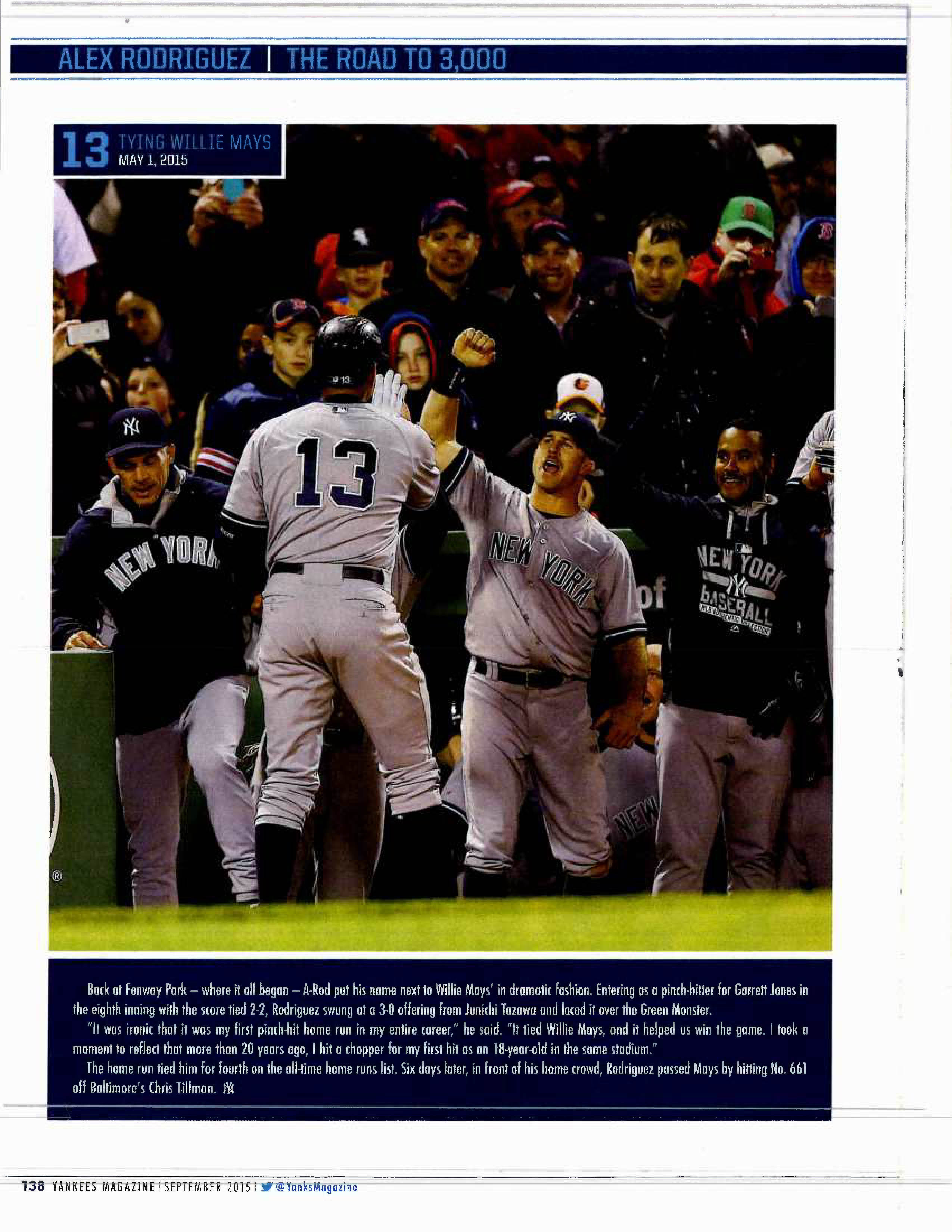
This is a story that I wrote for a Yankees Magazine package on Alex Rodriguez’s 3,000th hit. I was tasked with putting together a list of A-Rod’s most memorable career hits, and was able to get the Yankees’ slugger to weigh in them, offering insight into what made them special and particularly noteworthy.

In deciding how to put it together, I was torn between a simple write-thru, and a set out list. In the end, I settled on the latter, shifting between items that were simple quotes of A-Rod’s and others that I wrote out a short narrative. It’s a very simple story, but I was pleased with how it came out, both in terms of the content and its visual appeal.