Ain’t Life Grand


(This story originally appeared in the Spring 2018 issue of 
Yankees Magazine.)

Just like we did for the 1996 team in 2016 and the 1977 team in 2017, we decided to run a year-long series of Q&A features with members of the 1998 Yankees for the entire 2018 season. We got things started pretty hot with Tino Martinez, whose unforgettable grand slam in Game 1 of the World Series set the Yankees on a course for a sweep over the San Diego Padres, a rout befitting one of the greatest teams in baseball history.

I caught Tino during an event in Florida, where he was speaking to students attending one of the Steinbrenner family’s annual holiday concerts, then reading “A Visit From St. Nicholas” (better known as  “Twas The Night Before Christmas …”) while accompanied by a symphony orchestra. We chatted in his green room before the performance, and it was easy to tell how much Martinez enjoyed getting to look back at such an incredible career highlight. It’s mostly well-known at this point that up to that point, even through the wild 1996 run, Martinez had struggled in the postseason, even getting benched when the ’96 World Series moved to the NL park so that Joe Torre could keep his regular DH, Cecil Fielder, in the lineup.

The World Series grand slam, besides being one of those moments that literally every baseball fan has dreamed of in his or her backyard, is shown on the video board at Yankee Stadium enough that I can pretty much close my eyes and recall the entire at-bat. The key pitch, obviously, was the 2-2 offering, somehow called a ball (there’s no way it wasn’t a strike, sorry Tino). I had fun going back and forth with him about it, allowing him to maintain that it was a ball. Whatever. Baseball players are funny.

Anyhow, I can’t say that this broke all that much new ground, but it was fun to talk about an iconic moment in baseball history, part of a run by a team that is rightly celebrated among the sport’s elite. Hope you’ll enjoy.

https://www.mlb.com/yankees/news/tino-martinez-recalls-yankees-dynasty/c-267270982?tid=163658034

Back to the Future

(This story originally appeared in the Spring 2018 issue of Yankees Magazine.)

In the five months since I wrote this story, a few of the players have already been traded, so it was a bit funny to go back and read it last night. But I had a ton of fun reporting from the Arizona Fall League for the second straight year, and seeing some of the awesome prospects that are thriving in the Yankees’ system.

This year was a lot different from my 2016 visit, of course. In the course of that one year, the Yankees had gone from a team looking toward the future, to one very keenly aware of its arrival. Prospects are incredibly fun when you’re rebuilding, even if it’s a hyper-speed reload such as the one Brian Cashman put together during the 2016 season. But when I headed to Arizona this time, it was just a week after the Yankees’ season had ended in Game 7 of the ALCS. Times had changed, quickly.

Justus Sheffield (Photo Credit: New York Yankees)

And still, it was impossible not to be excited by some of the guys wearing the interlocking NY under the desert sun. Albert Abreu dazzled on the mound. Estevan Florial … the guy is special, and his talent screams out at you. Justus Sheffield sure seems like he’s going to be a star, and he took on something of an alpha-dog role mound the young future Yankees.

I did my best to highlight each guy out there, trying to show fans reading what they could look forward to in the months and years to follow. There was less immediacy than the year before, although Billy McKinney, one of the players out there this past year, would actually end up reaching the majors with the Yankees in the season’s first week, before a near-immediate injury cut down his time with the team. (He would then be traded at the deadline for J.A. Happ. Here’s hoping that he has a heck of a time in Toronto.

Their Estrada (Photo Credit: New York Yankees)

This is a light piece, a roundup, but I really loved checking in with these kids, and I’ll certainly be tracking their progress for years to come.

Hope you’ll read and enjoy.

https://www.mlb.com/yankees/news/yankees-prospect-base-stays-steady-in-2018/c-267272684?tid=163658034

The Final 42

(This story originally appeared in the Monument Park Commemorative Edition of Yankees Magazine. To purchase your copy, visit www.yankees.com/publications or call 800-GO-YANKS.)

I’ve always been of two minds about the idea of retiring uniform numbers. On the one hand, I certainly understand the sentiment — it’s a recognized means of appreciating greatness, and I’m on board with that. The downside to me, though, is that in doing so, your taking away the opportunity for players to recognize their heroes by choosing to wear the number. When Carlos Delgado wears 21 to celebrate Roberto Clemente, that’s obviously a meaningful tribute; does it really make sense that a player for the Pittsburgh Pirates can’t make the same choice?

I’m pretty sure that I’m in the minority on this, so I don’t feel any real need to harp on it. I kind of liked it a few years back when the University of Michigan — my alma mater — began honoring greats from the team’s past by “unretiring” their numbers. Essentially, they tried to establish the idea of wearing those numbers as a privilege, rather than celebrating the university legends by keeping their numbers out of rotation. I liked seeing Michigan QB Devin Gardner wearing 98, as a tribute to “Old 98” Tom Harmon. But again, your mileage may vary.

Embed from Getty Images

Anyway, that’s a long lead-in to this Q&A with Sharon Robinson, daughter to the legendary American pioneer Jackie. In 1997, on the 50th anniversary of his big-league debut, Major League Baseball retired Jackie’s No. 42 throughout the league, while grandfathering in the right for players already wearing the number to keep it until they retired. Mariano Rivera eventually became the last player in the league wearing the hallowed digits, even as it already hung in Monument Park, as it did at the other 29 Major League stadiums.

When Rivera finally retired after the 2013 season, the number went with him. Now it only appears every April 15, during the league-wide celebration of Jackie Robinson Day, at which all players on all 30 teams wear Jackie’s 42.

I think Sharon is a terrific person to speak with — I’ve long admired the way she honors her parents’ legacy by her work in educating children about the era in which her father played, and the struggles that continue. I thought a lot of her answers about Jackie’s legacy — and especially about Jackie as a father — were exceptionally interesting.

https://www.mlb.com/yankees/news/sharon-robinson-qa/c-263620308?tid=163658034

The Showman

(This story originally appeared in the Oct. 2017 edition of Yankees Magazine).

This one didn’t have much of a shelf-life. But I still really liked the story, and I enjoyed the process of reporting it.

Over the course of the 2017 season, I noticed that Joe Girardi’s YES Network television show was becoming surprisingly ambitious and interesting. What had once been just a camera on him in the manager’s office, recounting a week that anyone watching already knew all about, had turned into a series of trips around different cities with the show’s co-host, YES Network field reporter Meredith Marakovits. In Seattle, they went to the Starbucks Roastery. They made pizza in Chicago and visited his old dorm at Northwestern.

The trips showed a different side of the Yankees’ manager. Often chided for his reliance on on his binder, or his less-than-comfortable manner in front of the microphone (although I’d argue that over the second half of his Yankees tenure, he’d improved in both facets dramatically), Girardi was playful and engaging throughout the television broadcasts. He seemed, despite the artifice that the cameras necessitated, somewhat … real?

So I got them to allow me to tag along for a trip to the Dallas Cowboys’ sparkly practice facility north of Dallas. It was a quick trip — a night in Texas, total of about 20 hours. But it was great to see the whole shoot, to see how the show came together, to watch him engage with the Cowboys personnel (including head coach Jason Garrett). It was also, I have to say, a lot of fun to get to take the tour (even if it felt like a betrayal of my Giants roots).

I always got along well with Girardi. I think he’s a good man, with a good heart. I’ll never forget the times I got to watch him interact with young kids away from cameras, or the way he wore the shirts for different charities during every pregame presser for a few seasons. It was a remarkably kind gesture, and totally selfless. I doubt that he thought much about me either way, but I really got the sense of Girardi’s decency.

He also, it should be said, had a ton of success in New York, from the World Series championship in 2009, to the awesome performance by his 2017 group, that would end up a game shy of the World Series.

So, to put it mildly, there were a host of reasons I felt bad to see him let go once the team was eliminated, not the least of them being the fact that it made my feature about him in that month’s magazine look somewhat silly. But oh well. I still enjoyed the process, enjoyed the story, and enjoyed my four years working with Girardi.

https://www.mlb.com/yankees/news/yankees-manager-joe-girardi-show/c-258700434

Spreading The News

(This story originally ran in the September 2017 edition of Yankees Magazine).

Stories come from different places. Sometimes I’ll be watching a game and see something happen, and it will make me want to examine it further. Sometimes I’ll talk to a player in the clubhouse and find him incredibly interesting, making me want to have more and more conversations with him. Sometimes you just write what you’re assigned.

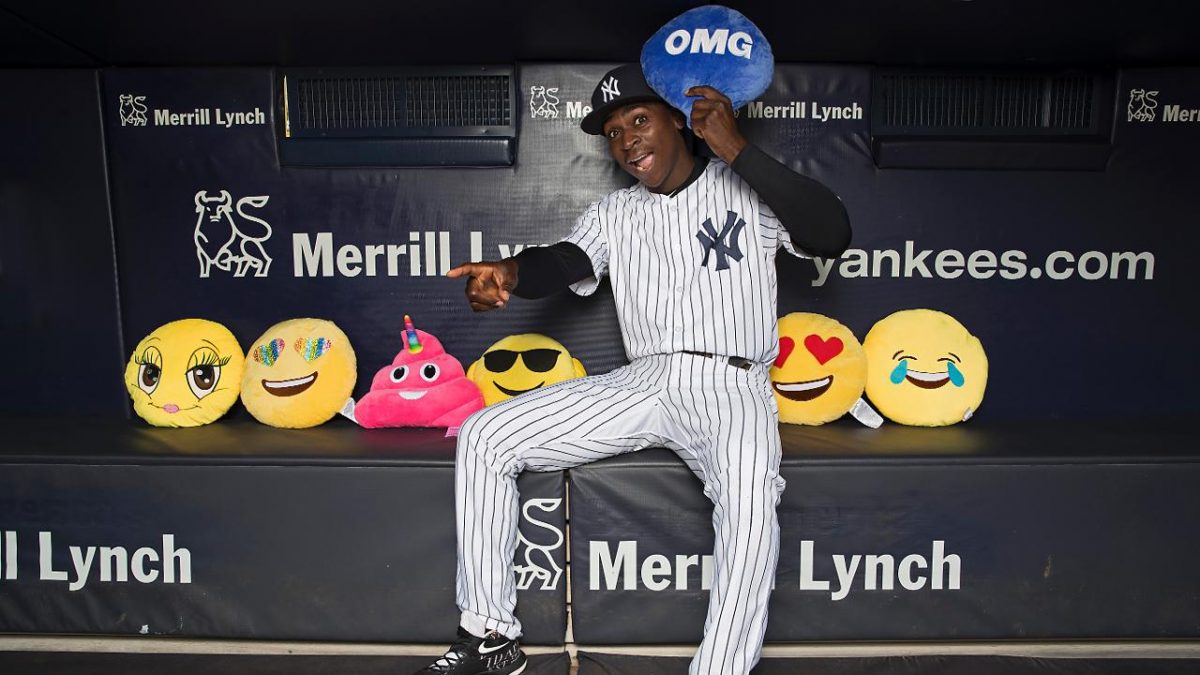
With this Didi Gregorius feature, though, my idea wasn’t for a story; it was for a photo shoot. I desperately wanted to organize a photo shoot of Didi engaging with various types of emoji.

Some background: after every Yankees win since the beginning of 2017, Gregorius has tweeted out a recap of the game rife with emoji, with different marks for each player. The tweets are whimsical and fun, but they drove reporters into a frenzy to try to figure out what each one meant, and Didi refused to say.

So I went on Amazon and bought a ton of different emoji paraphernalia — balloons, pillows, beach balls, etc — and put together a story about the whole phenomenon. In the process, I spoke with linguists who tried to explain to me how different brains might respond in different ways to the emoji; might it make sense that Gregorius, who famously speaks a handful of different languages, might have an easy way with the emoji keyboard?

Either way, I loved writing about the Yankees’ Rosetta Stone, and I hope you’ll enjoy the feature.

https://www.mlb.com/yankees/news/didi-gregorius-is-a-fan-favorite-in-new-york/c-253188212


Rise Up

(This story originally appeared in the August 2017 edition of Yankees Magazine.)

Right when the season started, I penciled in this trip to Miami. I had a feeling that Aaron Judge was made for an event such as the Home Run Derby, and I had to see it first-hand.

Remember, at the time, Judge was coming off a big-league debut that saw him hit just four homers in 84 at-bats, but the guy is so big and so powerful that it was obvious he was going to hit. I definitely don’t consider myself some sort of genius for figuring that it might be worth checking out.

That said, it obviously paid off. I’ve been to the Home Run Derby seven times now, and it’s hard to express just how much MLB improved the event with the new rules that were introduced a few years ago (this was my first time seeing the new format in person). The four-minute rounds are dramatic. They’re fun. They are — when you’re in town to write a story about a guy who is in danger of not advancing out of the first round — kind of agonizing.

My story is about Judge’s incredible performance, but it also tries to make sense of this larger-than-life character who seems to prefer to blend into the background wherever possible. I tried to figure out how he feels about all the attention and intrigue of the first half, and how his life has colored his perspective. Judge is a great guy, extremely friendly and kind, but it’s nearly impossible to get him to talk about himself. So I tried to piece the puzzle together myself. How does he do it? He’s not saying.

In between, I tried to get in some fun anecdotes from the weekend, such as the balls off the roof, the opposite-field shots, and the general excitement in Marlins Park. Hope you enjoy.

The Official News of New York Yankees

Source: Aaron Judge dazzled in All-Star Game, Derby | MLB.com

The Road

(This story originally appeared in the July 2017 edition of Yankees Magazine.)

This one will always have a special place in my heart. Donny Sands’ story is incredible, and I feel truly fortunate to have been able to tell it. But the nature of how I came to write about him is still amazing to me.

My plan, when I booked a trip to Charleston, was to interview Blake Rutherford, the team’s top pick in the 2016 Draft and the third-ranked prospect in the whole system. Along with my photographer, Jim Petrozzello, we were going to ride the bus with Blake from Charleston to Columbia, South Carolina, and my story would look at life in the low minors for a major prospect. I was excited about the story (and excited to visit Charleston and to see South Atlantic League baseball for the first time), but I’m not sure the feature would have been anything mind-blowing.

The night before I left, I was chatting with a Yankees PR staffer, and out of nowhere, he mentioned to me that Rutherford had just been placed on the disabled list. I had no idea. It hadn’t been announced anywhere (the team wouldn’t even announce it until late the next day, long after I arrived at the ballpark in Charleston). If not for that conversation, I would have gotten to the park and found out that the player I had traveled to see wouldn’t even be playing. Even if I somehow still got a story out of it, we wouldn’t have any photos of him in action. It would have been a disaster.

Instead, I had about an hour to research an alternate story, and with some help from a coworker and a tip from another writer in the Yankees press box — YES Network’s Lou DiPietro — I settled on Donny Sands. I had never heard of him before that moment, but it turned out that he was learned how to play catcher, transitioning from the infield, and I figured that could be enough of a story. Plus, it seemed like there was some vague tragedy in his past.

When I got to Charleston, Donny was totally willing to chat. He sat with us for a while as we went over the basics of what we wanted to do, how we wanted to follow him around for three days without having given him any notice, and how we wanted him to really open up to me, a guy he had never met or even heard of. But he was game for everything. And man, did he ever open up. I still can’t believe how raw the story he told was, how hard I found it to accept the way that he had totally been left behind by all of the people who should have been responsible for his education and even lodging. That he made it to the point he had was incredible enough; that he was so open about it was even more shocking. The luck kept going my way. While we were chatting that first day, I thought to myself that I needed to make sure to talk to Josh Paul, the Yankees’ roving catching instructor. Paul goes all around the minors, working with players, and he was playing a huge role in Sands’ position switch. As I’m thinking this to myself, Donny mentioned that Paul was actually in town. So instead of talking to Donny about the training and then talking to Paul, I was able to stand there with them and actually watch it happen. I don’t know what I would have done otherwise.

Another key factor in my lucky streak: in mid-July, Rutherford was traded. It would have destroyed my story. Instead, Sands keeps developing. He’s still far away from themajors, but just a few days ago, he was promoted to High-A Tampa. It’s a long road to the majors. But Sands is doing his thing.

Donny has an incredible story. I hope I did it justice.

http://m.yankees.mlb.com/news/article/240570356/nyy-prospect-donny-sands-developing-as-catcher/?topicid=163658034

(I also recorded an audio feature for the story as part of the Yankees Podcast (please subscribe in iTunes or wherever you get podcasts!)


A Change is Gonna Come

(This story originally appeared in the June 2017 edition of Yankees Magazine.)

Spring Training is often a time when I go around fishing for stories. The clubhouses are filled with players, and there are fewer amenities off-limits to media, which means that the players are generally more accessible. And they’re usually in a good mood, so you can be a bit more playful in terms of what you’re looking for. Where I’ll head to a clubhouse during the regular season with a definite idea for what I need and who I want to speak to, I’ll often just seek to chat with anyone I see during spring training. You never know what can come up.

So this year, with Commissioner Rob Manfred showing a willingness to evaluate the game’s practices (see: the odd new intentional walk, which I’m still not used to), I felt like it would be cool to talk to basically every player on the team about the same subject: What would they change if they could do anything?

A couple of interesting things happened: One, the morning after my first day of question the guys on the team on the topic, The New York Times ran a big package on the same idea — what would baseball writers change? So that bummed me out a bit. But the more players I asked, the more interested I got in how different the answers were. Some guys were totally selfish and playful — make the strike zone bigger, a few pitchers said; let me get a strikeout with one strike. Other players were totally into the idea of developing the ideas beyond the superficial. For instance, Brett Gardner and I got into a back-and-forth about his idea of limited pickoff attempts. How could you do that practically in a way that wouldn’t just eventually give a runner a free base? It was an interesting chat.

There was one topic I wanted to pursue further that I wasn’t able to. I noticed, anecdotally, that almost all of the Latino players I spoke with weren’t at all willing to criticize the game. Not in any way. Their quotes were all “I’m so lucky, this game is so great.” I tried to push further — was it too simplistic to attribute that feeling to their culture? Was there some other connection that I was missing? In the end, I dropped it. No one wanted to help me get into their own psyches on the matter, and I didn’t want to go psychoanalyzing them. I wish I would have been able to.

Either way, there’s some stuff in here I really like. I think that the Chase Headley stuff was really intriguing — he is a great guy to talk to, in that he’s completely willing to break down his swing and his thinking on everything. And he was very frank on both sides of the argument he was making, even as I pointed out that he was contradicting himself. I think he didn’t care, and I kind of think that made it feel authentic.

Anyhow, I hope you’ll read and enjoy.


Love Story

(This story originally appeared in the May 2017 edition of Yankees Magazine)

I’m so happy I got to write this story about the Negro Leagues Baseball Museum in Kansas City. It’s really a testament to my bosses at Yankees Magazine that they let me do this stuff. This is barely a Yankees story — I tried to get some Yankees and Yankee Stadium connections in there, but this is clearly a story about a museum in another city.

I was so lucky to be shown around the museum by Bob Kendrick and Ray Doswell. Kendrick, the president of the museum, is the voice of the late Buck O’Neil. His work is to keep Buck’s memory alive and vibrant, and throughout the museum, it’s so clear that he succeeds.

In my effort to expand the scope somewhat, I tried to focus on ways that the Negro Leagues endure in culture, and what that can help us understand about the way the game was played in that time and under those conditions. I focused on two things: Fences, the August Wilson play-turned-Denzel Washington/Viola Davis movie; and The Summer King, a new opera about Josh Gibson that debuted this past April in Pittsburgh. It was fascinating to dive deep into these two works, and I tried my best to do them justice.

This piece was an absolute joy for me in all facets. I hope you’ll read it.

http://m.yankees.mlb.com/news/article/227851232/yanks-play-kc-celebrate-negro-leagues-museum/?topicid=163658034

In His Blood

(This story originally appeared in the April 2017 edition of Yankees Magazine)

So this one was weird. It basically started by sheer luck. I was trying to plan an offseason reporting trip, looking for ways that I could get a few things done in one swing. I knew that Jacoby Ellsbury — who is believed to be the first player of Navajo descent to reach the majors — ran a camp for Native American youth in Arizona every year, and I thought it would be a good thing to cover.

As I kept doing more research, though, I kept finding amazing things that drew me in even more. By the end, I think I had enough for a book.

Ellsbury’s mother is from Parker, a town on a little reservation in western Arizona which belongs to the Colorado River Indian Tribes, collection of the Mojave, Hopi, Chemehuevi and Navajo tribes. His mother, Margie, is full-blooded Navajo, and in my research, I learned that she actually designed the CRIT flag.

Well, that was interesting. I started making random phone calls to anyone number I could find for the tribe and the town. One of the first calls I made went to voicemail. “Hi,” it said, “You’ve reached Esther McCabe.” Another McCabe (sure enough, Esther is one of Margie’s sisters). The whole thing kept going like that. It kept pulling me in.

Ellsbury is generally extremely private, not the easiest person to track down in the clubhouse, so I wasn’t sure how he was going to feel about my picking around in his past. But obviously, with his holding the camp for the kids at the same time, he was fine talking to me about the heritage, what it meant to him, and the like. His eyes lit up a bit when he heard that I was going to Parker. And he encouraged me to meet up with anyone I could from his family. I was honestly surprised that he didn’t push back at all, but I was grateful.

The last thing that happened, about two months later, when I was still writing — I ran into Ellsbury in the clubhouse in spring training. And he mentioned something to me that made me know I wasn’t making a story out of nothing, that the story I was telling was one that was deeply important to him. He told me (unprompted, out of nowhere) that when his wife gave birth to a daughter a month earlier, they had given her the middle name Parker.

The story that I tell isn’t particularly happy. The tribes have had a rough go of it, which isn’t surprising. But everyone I spoke with was so open, so warm, so interesting. Two members of the tribal council actually sat me down for a PowerPoint presentation about the whole history of the reservation. It was really incredible.

I’m so glad that I got to tell this story. I hope you’ll read it.

http://m.yankees.mlb.com/news/article/222040346/ellsbury-honors-his-native-american-heritage/?topicid=163658034