Master Craftsman

(This story originally appeared in the August 2018 issue of Yankees Magazine.)

I hope I’m wrong when I say this, but I’m not sure I’ll ever get to work on a more interesting reporting project. I had been circling something like this for a while, hanging out with a minor league roving instructor as he moved from town to town coaching different players. Between the Drew Henson scouting story that I wrote in 2016 and my feature last year about Donny Sands learning how to play catcher, I’ve long been fascinated by the people behind the scenes, the ones who help the players develop into major leaguers.

When I started asking around the Yankees front office, a bunch of people pointed me toward Danny Borrell, one of the team’s two pitching coordinators. I had never met Danny, had never heard of him, and didn’t really know what to expect. But he was open to the story from the start, and agreed to let me tag along on two trips — Staten Island and Pulaski.

The night before we started, he emailed me to say that he was actually going to be in Charleston instead of Pulaski, that something really big was happening. Normally, when big things happen around the team, we’re told to stay away. This was a rare case when I was being told that something huge was happening, and that I should make sure I was there for it. It was a no-brainer. 

He wouldn’t tell me what the big news was until after it happened, so we spent the first few days just watching the way he interacted with all the young minor leaguers — Short-Season A-ballers in Staten Island, then Low-A players in Charleston. It was fascinating. Danny would strap on catching gear and catch all the bullpens (despite being A: left-handed; and B: a former pitcher). He just has the most positive way about him, always laughing, joking, teaching. The best thing about writing minor league stories is that you really get total access. I have never stepped in the bullpen at Yankee Stadium, but while I was following Danny around, I was basically standing next to the pitchers as they were doing their workouts. It was awesome.

Danny let me hang out in meetings, he let me stand over his shoulder as he watched video with players, he let me stay next to him while he watched the games. The only time he told me he needed me to stay away for a few minutes was when they had the big meeting. As it turned out, they were taking Dermis Garcia — a pretty substantial prospect in Charleston — and letting him try to pitch. Garcia has never pitched, but his arm from third base was incredible, and Borrell had long been pining to get him onto a mound. And after Brian Cashman and his team spent time in the offseason pursuing Shohei Ohtani, they were encouraged enough by the idea of a two-way player to see if Garcia might have the chops to handle it. So they presented it to him, he enthusiastically accepted, and the next day, we stood right along the bullpen as Garcia threw off a mound for the first time in his life.

This story was an absolute joy to write, everything I could have hoped for and more. I don’t think I’ll ever have access like this again. I’m happy with how it came out.

https://www.mlb.com/news/danny-borrell-molds-yankees-young-pitchers/c-287603796

Heat Check

(This story originally appeared in the June 2018 issue of Yankees Magazine.)

I’ve wanted to write about fastballs for a while, and the Yankees make for good subjects. In Aroldis Chapman, they have the hardest thrower in MLB history. Luis Severino throws harder, more consistently, than any other starter in the game. So I wanted to answer a question with this story: What does all that speed actually add up to?

The fact is, every pitcher in today’s game is throwing gas. You just don’t see the “crafty lefty” all that much anymore, nor are there really any more knuckleballers coming up. The fact is, if you want to hit in the majors these days, you’d better be able to handle the heat.

So this story looks at how the speed works. What’s the difference between 90 mph and 100 mph? Austin Romine says that it all just feels fast once it gets above 95, but what does that difference actually mean? How do hitters time pitches that come in faster than they can blink?

Chapman’s past makes him hard for me to write about, so I’m happy that this didn’t turn into a simple profile of the guy, or any kind of celebration. I used his (for obvious reasons) as a jumping-off point, a way to tell the story about the incredible fastballs that have taken over today’s game.

Hope you’ll read and enjoy.


https://www.mlb.com/yankees/news/aroldis-chapman-leads-charge-for-flamethrowers/c-279908136

Rocket Man

(This story originally appeared in the May 2018 issue of Yankees Magazine.)

Like the Greg Bird feature I had the opportunity to write in October of 2016, this piece was almost a full year in the making, in a way that caught me totally by surprise. It started in June of 2017, when I was down in Charleston reporting a story on Donny Sands. Low-A baseball looks a lot different from what I’m used to seeing in the Bronx, but the truly elite prospects stick out. And I couldn’t take my eyes off this kid in the outfielder, a guy I’d never heard of named Estevan Florial. After the first game I saw down there, I met up with my photographer, and immediately, he asked me, “Hey, what do you know about Floral?” He was that impressive.

A month later, I was in Miami for the MLB All-Star Game, and Florial was one of two Yankees representatives in the Futures Game. One part of his story really interested me — the fact that he was from Haiti. Despite sharing an island with the Dominican Republic, which produces more baseball players than you can count, there has never been a major leaguer from Haiti. In the clubhouse before the game, I asked him about it (as he dressed in a uniform that had a Haitian flag on the chest). He told me that he was actually from the Dominican Republic, which confused me. I kind of restated the question, and he gave me the same answer. I figured there was some sort of language barrier (Florial speaks English well, but it’s still not his first language).

Fast forward three more months, and Florial is part of the contingent in the Arizona Fall League. I tried to find out again — what did he mean that he wasn’t from Haiti? Is he saying that he barely lived there, then moved to the DR? No, he told me. He was born in the Dominican Republic.

Now I was really confused, so I started poking around. What I found was a remarkable story of perseverance, of determination, of a great kid whose dream was almost broken by a well-intentioned system that was nonetheless unprepared to handle a story like his.

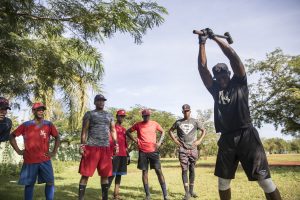
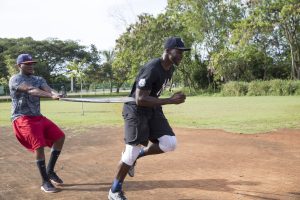
So when I was down in the Dominican Republic to report on my Luis Severino feature, I arranged to spend some time with Florial, as well. He gave me the whole story, the let me hang out as he worked out with some young kids and his old coach. I also spent some time with Bernie Tatis, the scout/manager/agent who discovered Estevan years ago, when he was named Haniel D’Oleo. 

This was a remarkable story, one I was privileged to tell. I hope I did Estevan and his family justice, and I’m so grateful he trusted me enough to open up the way he did. I definitely root for most of my story subjects to do well — especially with the minor leaguers, it just makes the story look better if the kid turns into something. But I don’t care if Estevan never makes it to the majors. I’ll always cherish the time he gave me, and I’ll always be proud of this story.


https://www.mlb.com/yankees/news/estevan-florial-ready-to-make-name-for-himself/c-274705446?tid=163658034


Open Season

(This story originally appeared in the May 2018 issue of Yankees Magazine.)

While I do travel quite a bit for stories, it’s pretty rare for me to actually join the team on the road during the season. Off the top of my head, I can think of two times since I started at Yankees Magazine that I reported on actual road games — the first was for my feature on Joe Girardi at the end of 2017, and the other was Opening Day 2018.

Something about the start of this season just felt important to me. Obviously, the Yankees had come so close in 2017, falling one game short of the World Series. And this was to be the first game for new manager Aaron Boone, as well as Giancarlo Stanton’s debut with the team. Plus, in the back of my head there was this sense that in the event this season turned out to be as special as Yankees fans and players were hoping, we should be there to document its first breaths.

So I flew to Toronto for a couple of days to watch the team work out for a last time in the preseason, then get things started the next day. The first couple weeks of April didn’t go so according to plan, but that first game sure did. Two homers from Stanton. An exceptional start by Severino. Handshakes to close things out.

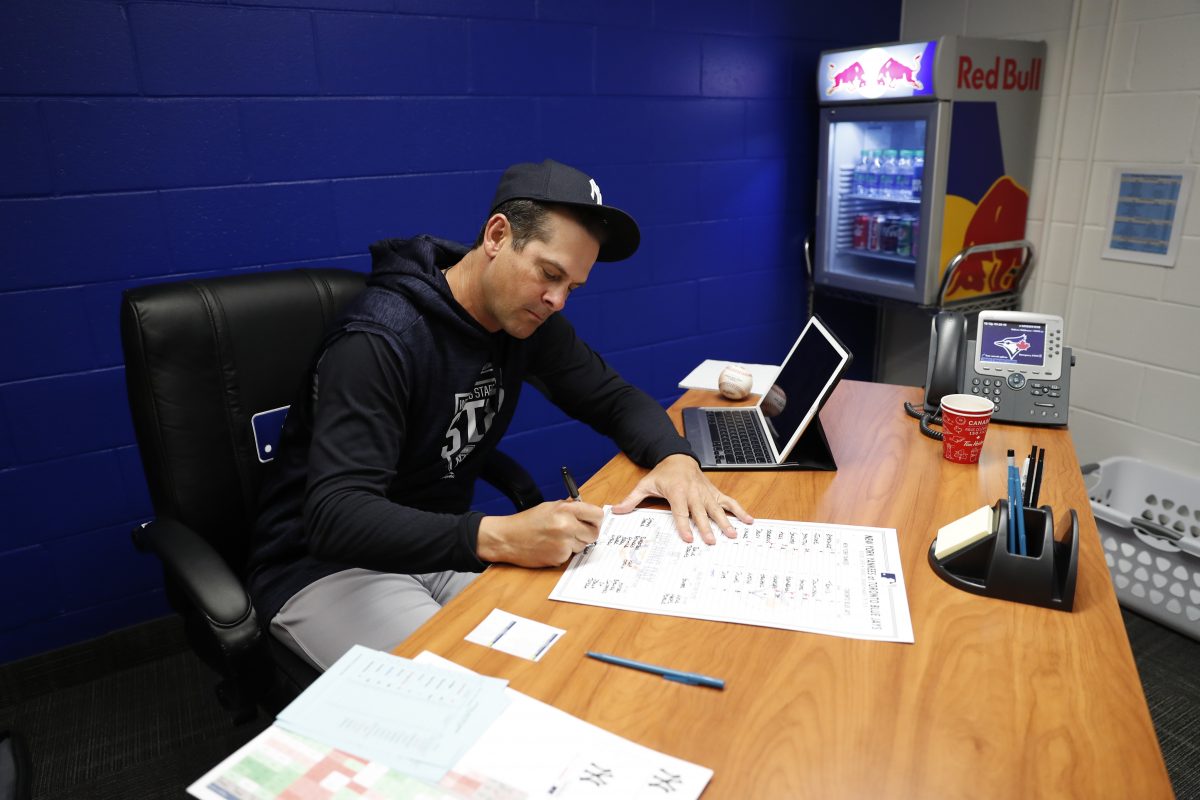
We had fun covering the newness all around us; at times, it seemed like Boone had no idea what to do with his hands. He was so fidgety, constantly holding a bat or a ball. I tried to get all of my observations into the piece.

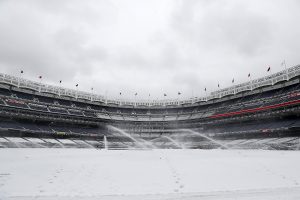
To keep the opening theme going, I also wrote about the curtain raising in the Bronx, even as it was delayed by a day due to snow. Once they got to play, it was Didi Gregorius leading the way, with a team-record 8 RBI from the shortstop position. Quite a debut, the first moments of what everyone hoped would be a truly special season.

Hope you’ll read and enjoy.

60-70 OPENING DAY FEATURE

Up, Down and Back Again

(This story originally appeared in the April 2018 issue of Yankees Magazine.)

I can’t say enough about how much I enjoyed writing this story, and how pleased I was with the outcome. I went down to Santo Domingo in January to spend some time with Luis Severino for this story, and with Estevan Florial for one that would run in May.

My goal was mainly to watch Severino work out, to see how what his life at home was like. I had never been to the Dominican Republic, so I really had no clue what to expect. But we all watched Sevy grow up before our eyes in 2017, then saw him crash head-first into a wall in the AL Wild Card Game. He lasted only a third of an inning that night, an utter disaster for a pitcher who would end up finishing third in AL Cy Young voting.

But when the Yankees came back to beat the Twins, Severino got another chance to show who he really was, and he was very effective the rest of the postseason. So the two of us spoke a lot about that whole roller-coaster experience, and how similar it was to what he experienced in 2016, when — after a brilliant 2015 debut — he was simply dreadful as a starting pitcher. He obviously came back in 2017 and showed what he could do, much as he did in the 2017 postseason. So what did he learn from that first turnaround? What was he applying? And how was he approaching his new role as the team’s ace, the eventual Opening Day starter?

I’m basically in awe of guys like Severino. So talented, so genuinely nice and interesting, such a bright future. One highlight of the trip was that we conducted our main interview with him at his apartment. All along, his wife and mother were in the kitchen cooking lunch. After we wrapped up, we shook hands and started to say goodbye, but he told us that we had to stay for lunch, that they were cooking for us, that we were their guests. I’ve been out to eat with players before during interviews, and it’s always a bit strange to share a meal under those circumstances. This was just a giant feast in the guy’s house, the food delicious and fresh. It was typical of the way that guests are treated in the culture, and my photographer was actually surprised that I had been so surprised. He had figured all along that they were cooking for us. Shows what I know.

That’s what the guy is like, though. I mentioned in a podcast recently that a lot of players, when they don’t want to deal with an interview, will say something like, “I’ve got to go run.” Severino will say that he has to go run, then he’ll go run, then he’ll come back and seek you out because he remembers that you needed him. He’s still so young, but he’s such a pro, a very easy guy to cheer for.

Hope you enjoy this one.

https://www.mlb.com/yankees/news/luis-severino-armed-with-2017-playoff-lessons/c-269277258?tid=163658034


A Change is Gonna Come

(This story originally appeared in the June 2017 edition of Yankees Magazine.)

Spring Training is often a time when I go around fishing for stories. The clubhouses are filled with players, and there are fewer amenities off-limits to media, which means that the players are generally more accessible. And they’re usually in a good mood, so you can be a bit more playful in terms of what you’re looking for. Where I’ll head to a clubhouse during the regular season with a definite idea for what I need and who I want to speak to, I’ll often just seek to chat with anyone I see during spring training. You never know what can come up.

So this year, with Commissioner Rob Manfred showing a willingness to evaluate the game’s practices (see: the odd new intentional walk, which I’m still not used to), I felt like it would be cool to talk to basically every player on the team about the same subject: What would they change if they could do anything?

A couple of interesting things happened: One, the morning after my first day of question the guys on the team on the topic, The New York Times ran a big package on the same idea — what would baseball writers change? So that bummed me out a bit. But the more players I asked, the more interested I got in how different the answers were. Some guys were totally selfish and playful — make the strike zone bigger, a few pitchers said; let me get a strikeout with one strike. Other players were totally into the idea of developing the ideas beyond the superficial. For instance, Brett Gardner and I got into a back-and-forth about his idea of limited pickoff attempts. How could you do that practically in a way that wouldn’t just eventually give a runner a free base? It was an interesting chat.

There was one topic I wanted to pursue further that I wasn’t able to. I noticed, anecdotally, that almost all of the Latino players I spoke with weren’t at all willing to criticize the game. Not in any way. Their quotes were all “I’m so lucky, this game is so great.” I tried to push further — was it too simplistic to attribute that feeling to their culture? Was there some other connection that I was missing? In the end, I dropped it. No one wanted to help me get into their own psyches on the matter, and I didn’t want to go psychoanalyzing them. I wish I would have been able to.

Either way, there’s some stuff in here I really like. I think that the Chase Headley stuff was really intriguing — he is a great guy to talk to, in that he’s completely willing to break down his swing and his thinking on everything. And he was very frank on both sides of the argument he was making, even as I pointed out that he was contradicting himself. I think he didn’t care, and I kind of think that made it feel authentic.

Anyhow, I hope you’ll read and enjoy.