Sweet Relief

(This story originally appeared in the June 2021 edition of Yankees Magazine.)

Some stories age better than others. This wouldn’t end up being my most regrettable feature of 2021 (that would be a tie between my Deivi García feature from the spring, and my Gerrit Cole piece that ran on the morning of his disappointing start in the AL Wild Card Game), but it was a bit of a shame. About the only saving grace here is that the Corey Kluber no-hitter bumped this off the cover, as it would have been a bit embarrassing for this to be on sale all June, when the Yankees’ relievers were going through their roughest patch of the season.

New York Yankees 2021

With that said, I do think there’s some good stuff in here, a look at what makes a bullpen great. The Yankees spent 2021 deploying tons of different arms and arsenals, baffling opponents with arm angles and a rambunctious kindergarten class worth of breaking stuff. For all that we talk about speed these days, and all the relievers that throw in triple-digits (and the Yankees have plenty of those), the best recipe seems to be mixing approaches, changing deliveries and just throwing strikes. Up through the point when I wrote this, the Yankees were doing that at a pace about as good as any bullpen in history.

Baseball is changing, and bullpens are more important than ever. Clearly the Yankees have known this for a long time, which is why they had a bullpen with something like five guys who could probably close for a bunch of teams. While they fell off the historic pace, the bullpen was still an incredible strength for the team down the stretch, and figures to be for years to come.

https://www.mlb.com/news/yankees-magazine-dominant-bullpen

End Game

(This story originally appeared in the September 2018 edition of Yankees Magazine.)

As the 2018 trade deadline approached, it seems that the Yankees were in desperate need of a starting pitcher. So general manager Brian Cashman went out and acquired one of the best … relief pitchers? … on the market? On the surface it made little sense. But baseball is changing, and all you need to do is look at the ways that the Oakland A’s and Tampa Bay Rays approached this year to see it. And sure, the Yankees are playing their part, too.

Starting pitchers are throwing fewer innings than ever, and since the game is still nine innings long, that means that managers and pitching coaches are being forced to rely on relievers more than ever before. So in Zach Britton, Cashman added a fourth elite closer to the Yankees’ bullpen, joining Aroldis Chapman, Dellin Betances and David Robertson.

For this story, I tried to introduce Britton to Yankees fans, while also looking at what the acquisition can tell us about the new team-building philosophies at play. I had never interviewed Britton before this, and we had a really fun chat. He’s incredibly honest and thoughtful in his answers. A highlight for me was when we talked a lot about all of the high-leverage situations he would face in his hybrid role on the Yankees’ roster. An experienced closer who wouldn’t be doing much ninth-inning work, he was excited about the change, anxious to add a new club to his bag. Britton is enough of a student of the game (in particular, of the ways that former Yankee Andrew Miller has thrived in a unique bullpen role) to know that the idea of the ninth inning being where all the money is made doesn’t really make sense anymore.

But at the same time, he admitted that he couldn’t really explain why it was still important to him, why he still expected that when he enters free agency after the 2018 season, he expects to find a job closing again. He was almost treating it like a thought experiment, brainstorming responses. “I have the American League record for consecutive saves,” he told me, more thinking out loud than anything else. It turns out, the game might be changing faster than even the players can comprehend (for more on this, ask Greg Bird about the shift. Then back away slowly).

I think it’s going to be fascinating to see how all of this develops in the coming years. In the meantime, I hope you’ll check out this story.

https://www.mlb.com/yankees/news/britton-trade-added-to-yankees-deep-bullpen/c-294600990?tid=163658034

Heat Check

(This story originally appeared in the June 2018 issue of Yankees Magazine.)

I’ve wanted to write about fastballs for a while, and the Yankees make for good subjects. In Aroldis Chapman, they have the hardest thrower in MLB history. Luis Severino throws harder, more consistently, than any other starter in the game. So I wanted to answer a question with this story: What does all that speed actually add up to?

The fact is, every pitcher in today’s game is throwing gas. You just don’t see the “crafty lefty” all that much anymore, nor are there really any more knuckleballers coming up. The fact is, if you want to hit in the majors these days, you’d better be able to handle the heat.

So this story looks at how the speed works. What’s the difference between 90 mph and 100 mph? Austin Romine says that it all just feels fast once it gets above 95, but what does that difference actually mean? How do hitters time pitches that come in faster than they can blink?

Chapman’s past makes him hard for me to write about, so I’m happy that this didn’t turn into a simple profile of the guy, or any kind of celebration. I used his (for obvious reasons) as a jumping-off point, a way to tell the story about the incredible fastballs that have taken over today’s game.

Hope you’ll read and enjoy.


https://www.mlb.com/yankees/news/aroldis-chapman-leads-charge-for-flamethrowers/c-279908136

Short Track

(This story originally appeared in the 2017 New York Yankees Official Yearbook)

As I write this, Gleyber Torres is injured, and out for the rest of the 2017 season, which is a shame, because I can’t wait to see what happens when New York gets to know this kid. Acquired by the Yankees in the 2016 trade that sent Aroldis Chapman to the Cubs, Torres was said to be a stud, but as someone who pays incredibly little attention to midwestern teams’ farm systems, I didn’t really know anything about him other than what I could see on his Baseball-Reference page.

But in August, soon after the trade, I headed down to Tampa to meet with him and some of the other newly acquired prospects. And I was absolutely blown away by his poise, his maturity, his savvy. After he posed for a bunch of photos, he asked the photographer to let him see them. It was a small move — most guys just want to move on as quickly as possible, but he cared about how he looked. It didn’t come across as vain, just a kid in control.

Similarly, during the photo shoot, we were hanging out at second base (when I’m not interviewing, I’m often helping out by holding a light or something else in these situations). We were making easy small talk in English, just a normal conversation. Torres, from Venezuela, didn’t even appear to be struggling. But when it came time to sit down for the actual interview, he called over a translator. Again, he wanted to be perfect. I have no doubt that he would have been just fine doing the interview in English, but I totally respected the fact that he wanted to do it his way. I think that as long as translators are available, players should use them if it makes them comfortable.

Anyhow, no one should care about how Torres behaved toward me the first times I met him. But I honestly think that it was indicative of a guy who just won’t settle for anything other than perfection, and if he’s that way with interviews, I expect him to put similar work into what he does on the field. Watching him at the Arizona Fall League a few months later, and then during spring training this year, the impression stuck.

I figure he’ll be competing for a role with the big club when spring camp opens in 2018. I hope so. I really can’t wait to see him play in New York.

Hope you’ll enjoy.

http://m.yankees.mlb.com/news/article/221541182/yankees-gleyber-torres-living-up-to-hype/?topicid=163658034


Bit by Bit, Putting it Together

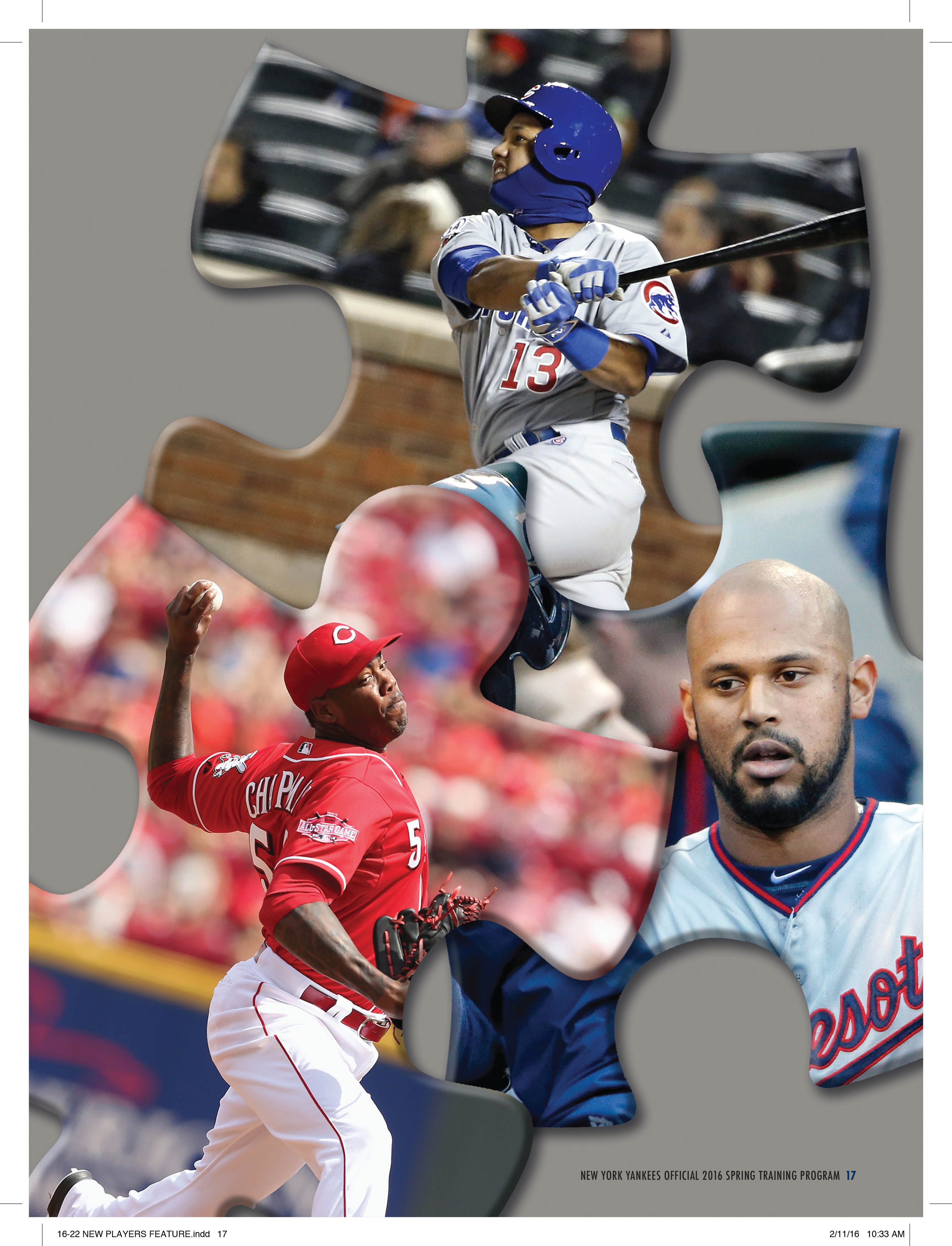
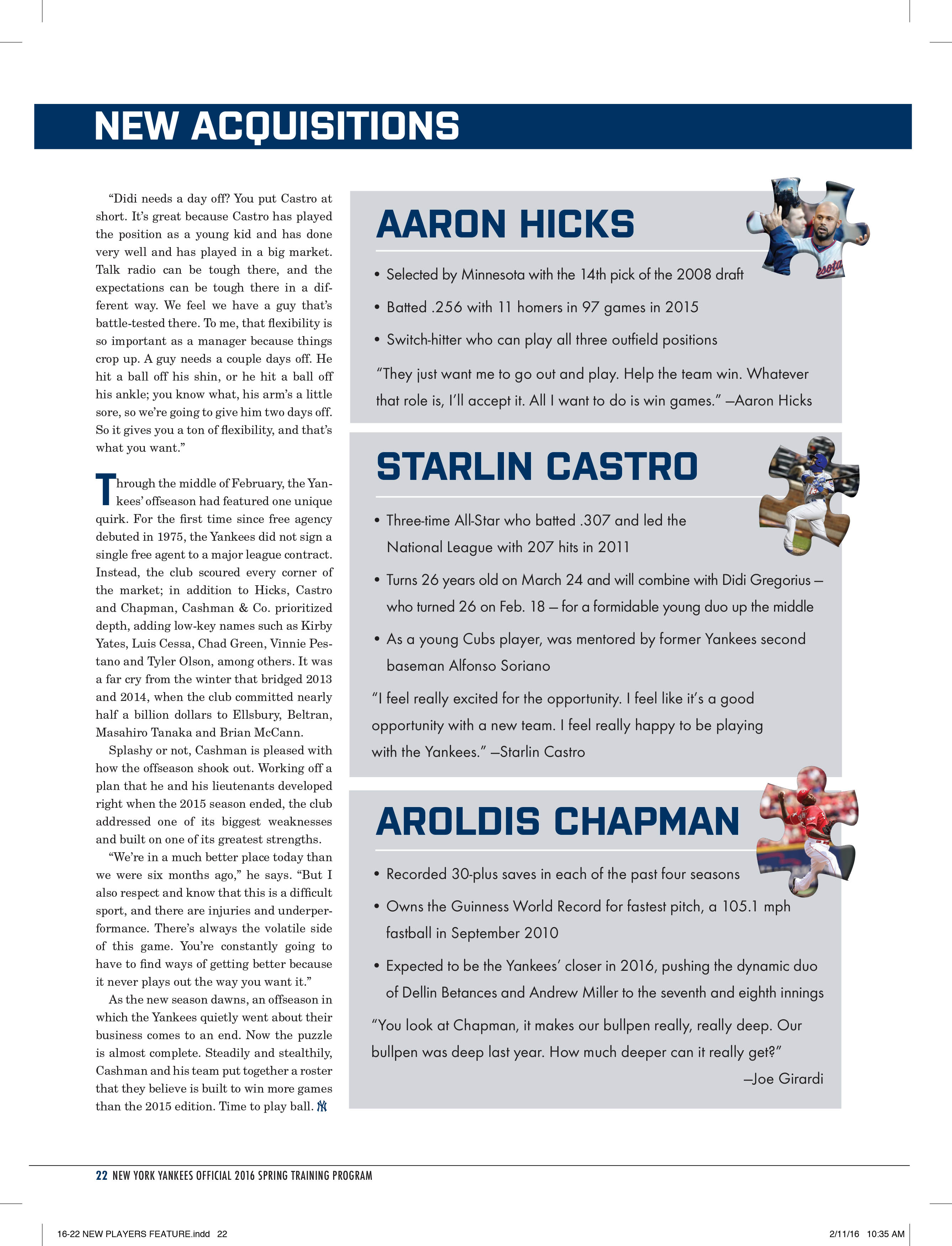
For the 2016 Yankees Yearbook (and the Spring Training issue of our magazine), I was assigned to write about the Yankees’ offseason acquisitions. About a decade ago — even less, really, when you consider some recent offseasons like 2008-09 and 2013-14 — it would have seemed crazy to think of how uneventful the past few months were in the Yankees front office. For the first time since free agency began, the club didn’t sign a single player to a major league offer.

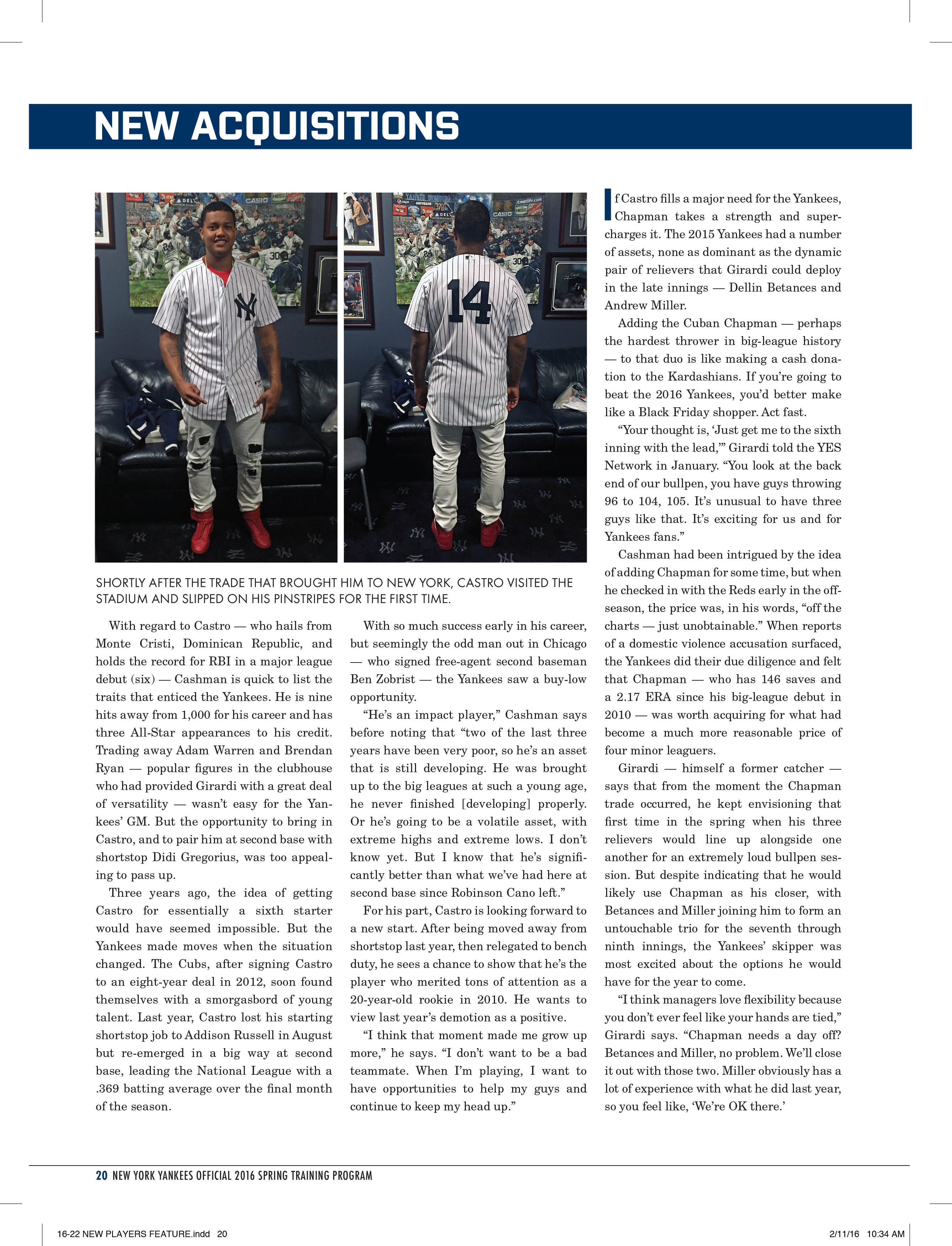
As such, putting the story together was a bit more challenging than I would have originally thought. How much was there to say about adding a fourth outfielder in Aaron Hicks, a castoff middle infielder in Starlin Castro, and a closer facing discipline for domestic abuse in Aroldis Chapman.

Obviously, there’s no way to write about the Yankees’ offseason in a way that makes it seem like the club signed David Price and Jason Heyward. But in talking to people around the office, I got to understand some of the philosophical foundation on which the offseason was built. I think the story that resulted was a compelling look at a quiet — but possibly quite impactful — few months.