(This story originally appeared in theSeptember 2021 edition of Yankees Magazine.)
For Part 2 of my overhead view of pandemic baseball, I focused mainly on the sights and (lack of) sounds in Yankee Stadium. Covering baseball in 2020 was an enormous challenge, with magazine deadlines looming and black pages staring back at you despite next to no access to the players. One of the great joys of writing about baseball is the downtime. As frustrating as it can be sometimes to stand around a Yankees’ clubhouse with 50 other reporters and no baseball players to be found, there’s still so much that we can all learn from getting to chat with players, to make small talk, to ask questions out of view of the entire beat.
Obviously, everyone knew that things would be different in 2020, but as one of very few people who could be in the park during games, I really wanted to give a sense of what it looked and sounded and felt like. I wanted to know how players got themselves amped up, how gameday operations employees tried to get some sound into the atmosphere to trick the players’ brains, and how everyone tried to make the games feel as normal as possible. I also spent time chatting with all the people who made the YES Network broadcasts work despite the announcers sometimes calling games from three time zones away.
I’m proud of this series, and of the way that I think it will stand as a reminder of how weird everything was in 2020, even when we were kind of pretending things were normal again.
(This story originally appeared in the August 2020 edition of Yankees Magazine.)
I can’t say that I’ve ever been one of those baseball fans who obsesses over prospects. The fact is, there’s so much projection involved, so much luck, so much precarious uncertainty, that sometimes it’s just smarter to wait until they do something before you fall in love. It helps that the teams that a I root for / work for are in big markets (or, in the case of the Mets, are in a big market but insist on pretending that they’re not) and are usually trading prospects for major league–ready players, rather than the other way around.
With that said, most of my favorite stories to write during my time in baseball have been minor league features. The access is about 4,000 times better than what you get with big leaguers and the stories are just more interesting. Sure, there are grinders who you’ll find in a big-league clubhouse, but it’s not too often that you’re going to be the one to tell the ultimate story about a guy’s harrowing adventure to establish an identity, as I was able to do with Estevan Florial, or to shine a light on the tumultuous life of a low-minors infielder who — having overcome homelessness during high school — is learning to play catcher on the fly, as I could with Donny Sands. When I lucked into telling the story of the Yankees attempting to turn Dermis Garcia into a pitcher, it was the type of feature that almost by definition couldn’t come from the clubhouse in Yankee Stadium. They just don’t do that stuff up in the majors.
New York Yankees
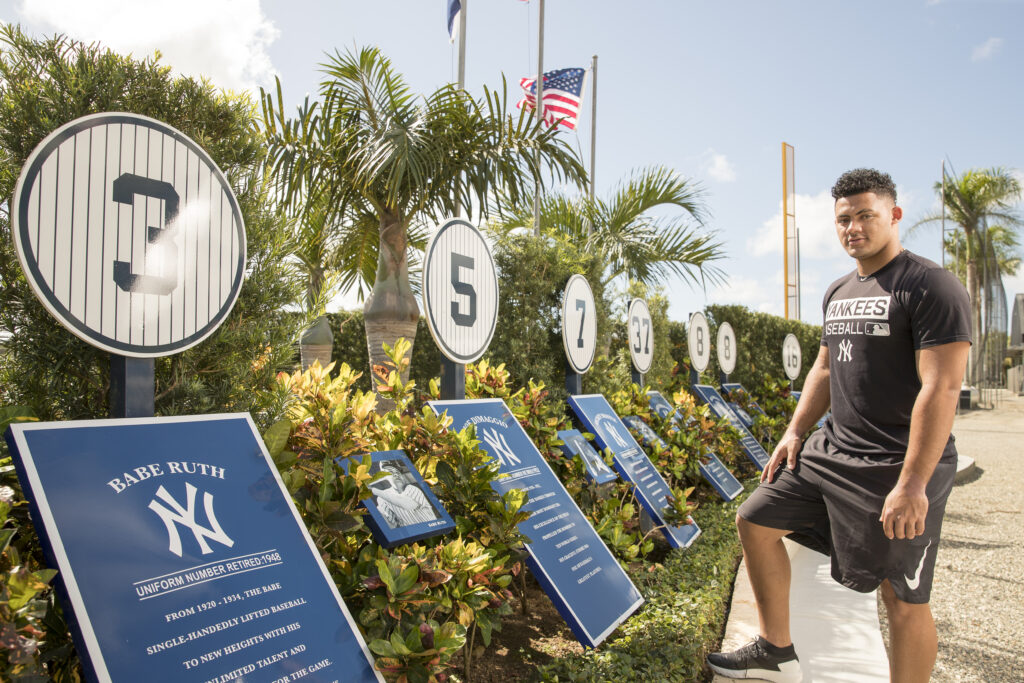
With Jasson Dominguez, some of both sides of that dichotomy came into play. First off, he’s as exciting a prospect as you’ll see, this massive tank of a person, just 16 years old when we were chatting. He’s a kid, but he’s also the guy who signed the biggest contract ever in the international signing period. The Yankees made a huge bet on the young Dominican, and when you see him for the first time, all you can do is nod and say, “Yeah, that makes sense.” As Donny Rowland, the Yankees’ international scouting director, said, “He’s the kind of player that makes the hair on your arm stand up when you watch him”
Back in January, I spent a few days with Jasson at the Yankees’ Dominican Baseball Academy. This was before the world came crashing down, as the youngster was embarking on his first full year in the system, starting down a road that could eventually lead him to the Bronx. I was there on his first day of on-field work for the year, when he struggled to make a nice-and-easy toss to his throwing partner. I watched him airmail like 12 balls, worried that my presence was making this kid nervous. Then it hit me: he’s never thrown a ball nice and easy in his entire life. Dominguez had been working since he was about 5 years old for the chance to play on a big-league field. He’s had scouts and advisers watching him his whole life, a constant need to put on a show. His life has been about showing how hard he could throw, not about showing that he could just toss a ball back and forth. It was illuminating, in not entirely positive ways.
Who knows what this lost year will do the Dominguez’s timeline. It was possible that he could have spent some time in one of the American short-season leagues this year, whether in Pulaski or Staten Island. Instead, he continues to wait. And while he does, the legend of the Martian will continue to grow in absentia.
I really enjoyed writing this one. It was fun to meet Jasson, fun to tell his story, and it’s always nice to go to the Dominican Republic (I even got to check out a game in the Dominican World Series while I was there, which was awesome). Who knows how long it will be before I can travel for another baseball story, so that part makes for a fun memory, as well.
This one came out of nowhere. I was planning on traveling to Las Vegas for a conference, and because I was going two-thirds of the way across the country, and because a co-worker had a sudden conflict arise, my editor suggested that I follow up the Vegas trip by checking out an Aaron Judge All Rise Foundation event in Fresno, California. Obviously, I wasn’t about to say no to that.
Since I was heading out there with a few days to spare, I somehow convinced Aaron’s people to let me go to the fundraising dinner they were holding, then spent some time at Fresno State’s football game two nights later, where they honored Judge on the field. In between, I used some downtime to check out Yosemite National Park.
The story that I eventually wrote came out a lot of confusion I was feeling throughout my time in Fresno. The events were … small? I don’t mean that in a negative way, and I think it’s probably a function of my New York–area mentality that I even bumped against it. But the fundraiser didn’t have any media, didn’t have any celebrities. It certainly could have. If Judge had allowed the media inside (or even outside), plenty of reporters would have jumped at the chance. I was there almost by accident.
In spending time around the family, and with Aaron’s agent, what became very clear was that this was by design. It’s not that they don’t have big goals for the foundation, it’s just that they want to honor those who have been with them from the start. What they seem to be saying is that there will come time for the massive events. For now, though, better to reward those who have been loyal. It was blindingly obvious as I watched Aaron chatting with his former college teammates that it just doesn’t cross his mind that there might be some distance between them, some difference in where the world has taken them. That’s remarkable, and it’s a skill!
Aaron’s family is insistent on loyalty, almost fanatically so. And as you talk to his parents, Patty and Wayne, and watch them interact with people, you can see how Aaron became the way he is, the standup superstar in New York, the humble megastar.
I really tried to show that side of him, and the way he got where he is. Largely, what I saw was that he is who he has always been, in a good way. I hope you’ll read and enjoy.
(This story originally appeared in the August 2019 edition of Yankees Magazine.)
I wasn’t born when Thurman Munson died, and for most of my life, I kind of viewed him through a lens of a cynical outsider. It was easy to kind of dismiss him as a guy beloved on account of a tragic ending.
I had never really forced myself to look at how impressive he was on the field, what he meant to fans in life, not just in death, the way he operated in the clubhouse and on the field. For any cynicism I have had about Derek Jeter’s role as a Yankees captain, I think I was similarly blind, prone to undervaluing Thurman Munson.
So it was great to spend as much time as I did this summer researching him, leading up to an afternoon in Canton, Ohio, that I’ll never forget, when I spent time with his widow, Diana, and his son, Michael.
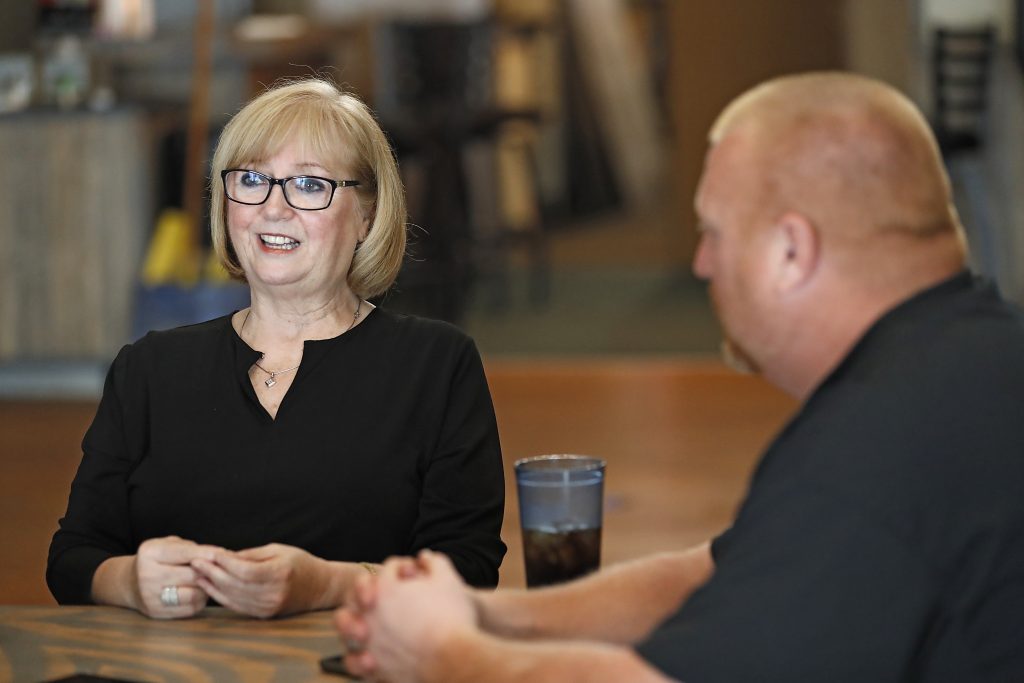
We met at Michael’s bar, then spent hours chatting. I learned more than I could have imagined. Diana was open about Thurman’s less-awesome qualities, candid about the ways that he could be a bully. I saw her pugnaciousness, the ways that she would push back against him.
But what I saw the most was the way that she carries on as Thurman’s legacy, a real living monument. She ripped open scars and told me about the worst moments of her life, but also spoke at length about her work to keep her late husband’s memory at the forefront. She continues raising money for the AHRC, continues showing up at Yankee Stadium on Old-Timers’ Day, so that the fans can cheer her for her husband.
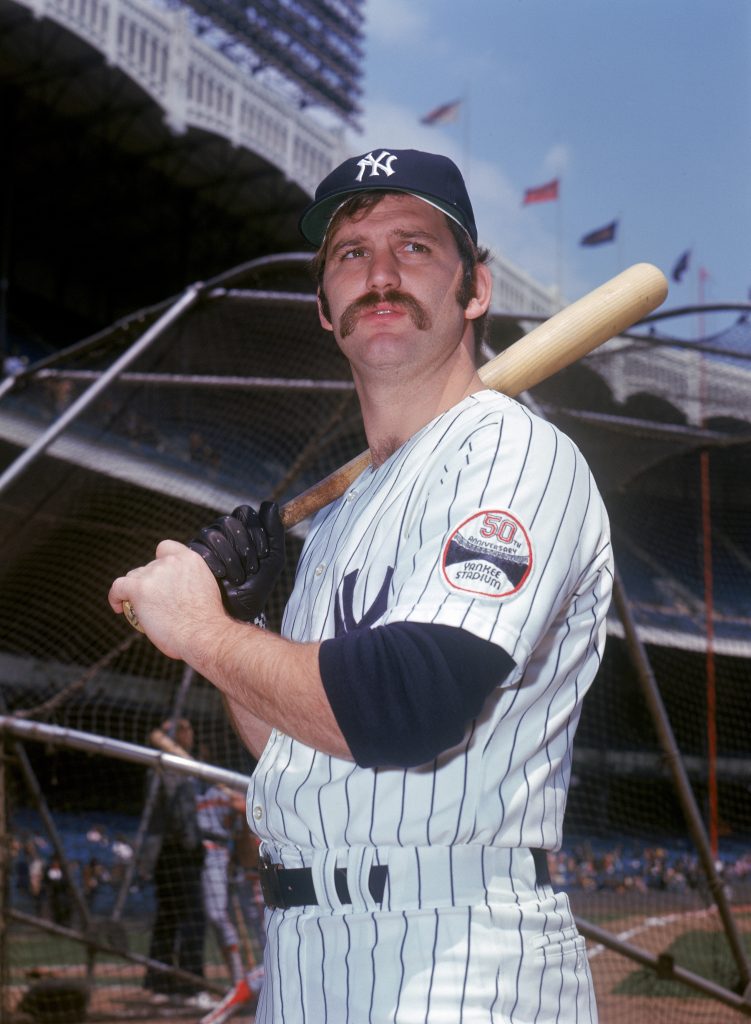
NEW YORK – UNDATED: Thurman Munson #15 of the New York Yankees poses for a portrait circa 1969-79 at Yankee Stadium in the Bronx, New York. (Photo by Louis Requena/MLB Photos via Getty Images)
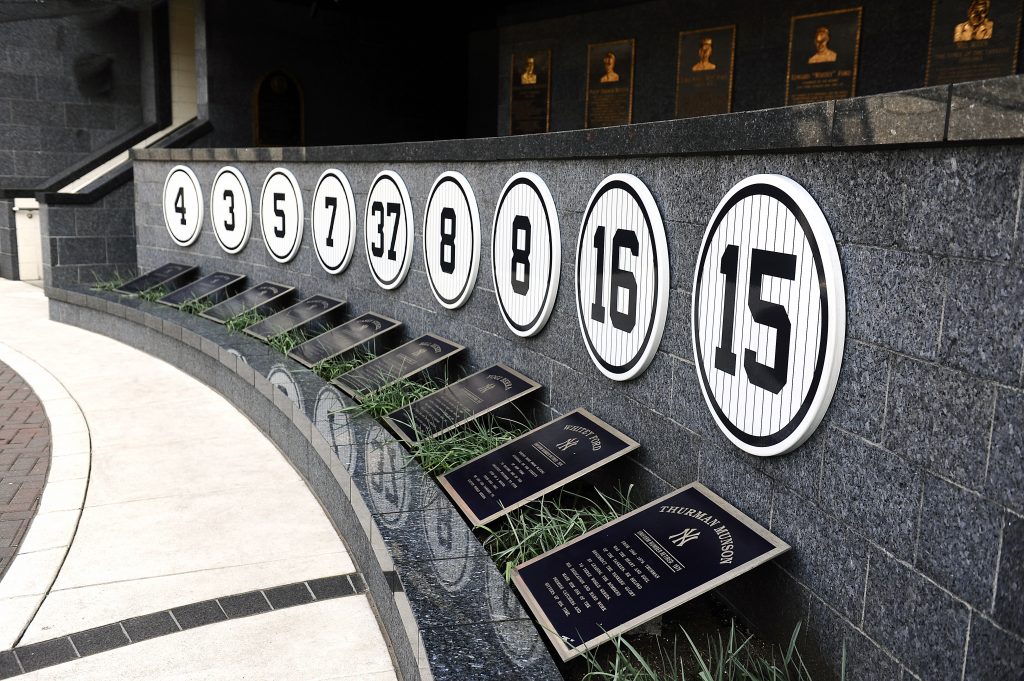
During my time in Canton, and certainly around Yankee Stadium, I tried to find as many monuments to the late captain as I could. Along with a photographer, Barrie Schneiderman, I drove around town, to the stadium that bears his name, the street named for him, the large and impressive gravestone. We drove past the airport and the field where his life came to an end. In New York, we saw his locker, his number 15 on the backs of fans way too young to have cheered for him.
I tried to tell a big story here. The way that Diana has kept her husband alive in the 40 years since he died. It was a special story to tell, not the least because of how much I learned in the process.
(This story originally appeared in the May 2019 edition of Yankees Magazine.)
Nothing too crazy here. I’d dealt with Patrick Osborn a time or two, and he seemed like a fun, youthful, interesting guy. In particular, I liked that he was managing Double-A, the same level at which he petered out during his own career. So essentially, he was trying to teach players to do something that he, himself, wasn’t able to do.
Pat let me hang with him for a full day, in meetings, during downtime, and even in the dugout during the game. It was fun watching the whole day play out, and I think the story is a fun look at life on the farm. ]
(This storyoriginally appeared in the April 2019 edition of Yankees Magazine.)
This one really fell into my lap, and I can’t say enough about how grateful I am for that. A colleague on the Tampa side of the Yankees’ operation emailed a co-worker to mention this interesting story about a Yankees draft pick who was allowed to keep his long hair, which goes against the team’s well-known (and oft-mocked) grooming policy. She mentioned that it might be cool as short item for the front of book section.
Basically, the story was that the player, Tyler Johnson, was growing out his hair to make a wig for his mother, who had been diagnosed with leukemia. My coworker had recently taken another job, so she passed the email on to me, and I was intrigued right away.
I had no idea how amazing the story would become, though.
It turns out, Tyler had his own dramatic and traumatic medical history, one that shaped his mentality and his whole life. So he was determined to pitch professionally, and his mother was determined to watch him pitch professionally, and it was all a crazy pipe dream, until it wasn’t. But on that fateful day when the Yankees drafted him and told him to cut his hair, he explained the situation. Eventually, the question made it all the way to the team’s owner Hal Steinbrenner, who insisted that Johnson not cut his hair until he could get it long enough to make the wig.
This was a heart-wrenching story to write. Tyler’s mom, Bethanne, walked me through years of nightmares, of horror I could never imagine. Tyler told me stories I simply couldn’t conceive of. I would hang up and wipe tears from my eyes. Instead of a small item on a quirky, out-of-place hairdo, it became one of the most meaningful stories I’ve ever had the privilege to write.
(This story originally appeared in the August 2018 issue of Yankees Magazine.)
I hope I’m wrong when I say this, but I’m not sure I’ll ever get to work on a more interesting reporting project. I had been circling something like this for a while, hanging out with a minor league roving instructor as he moved from town to town coaching different players. Between the Drew Henson scouting story that I wrote in 2016 and my feature last year about Donny Sands learning how to play catcher, I’ve long been fascinated by the people behind the scenes, the ones who help the players develop into major leaguers.
When I started asking around the Yankees front office, a bunch of people pointed me toward Danny Borrell, one of the team’s two pitching coordinators. I had never met Danny, had never heard of him, and didn’t really know what to expect. But he was open to the story from the start, and agreed to let me tag along on two trips — Staten Island and Pulaski.
The night before we started, he emailed me to say that he was actually going to be in Charleston instead of Pulaski, that something really big was happening. Normally, when big things happen around the team, we’re told to stay away. This was a rare case when I was being told that something huge was happening, and that I should make sure I was there for it. It was a no-brainer.
He wouldn’t tell me what the big news was until after it happened, so we spent the first few days just watching the way he interacted with all the young minor leaguers — Short-Season A-ballers in Staten Island, then Low-A players in Charleston. It was fascinating. Danny would strap on catching gear and catch all the bullpens (despite being A: left-handed; and B: a former pitcher). He just has the most positive way about him, always laughing, joking, teaching. The best thing about writing minor league stories is that you really get total access. I have never stepped in the bullpen at Yankee Stadium, but while I was following Danny around, I was basically standing next to the pitchers as they were doing their workouts. It was awesome.
Danny let me hang out in meetings, he let me stand over his shoulder as he watched video with players, he let me stay next to him while he watched the games. The only time he told me he needed me to stay away for a few minutes was when they had the big meeting. As it turned out, they were taking Dermis Garcia — a pretty substantial prospect in Charleston — and letting him try to pitch. Garcia has never pitched, but his arm from third base was incredible, and Borrell had long been pining to get him onto a mound. And after Brian Cashman and his team spent time in the offseason pursuing Shohei Ohtani, they were encouraged enough by the idea of a two-way player to see if Garcia might have the chops to handle it. So they presented it to him, he enthusiastically accepted, and the next day, we stood right along the bullpen as Garcia threw off a mound for the first time in his life.
This story was an absolute joy to write, everything I could have hoped for and more. I don’t think I’ll ever have access like this again. I’m happy with how it came out.
(This story originally appeared in the May 2018 issue of Yankees Magazine.)
While I do travel quite a bit for stories, it’s pretty rare for me to actually join the team on the road during the season. Off the top of my head, I can think of two times since I started at Yankees Magazine that I reported on actual road games — the first was for my feature on Joe Girardi at the end of 2017, and the other was Opening Day 2018.
Something about the start of this season just felt important to me. Obviously, the Yankees had come so close in 2017, falling one game short of the World Series. And this was to be the first game for new manager Aaron Boone, as well as Giancarlo Stanton’s debut with the team. Plus, in the back of my head there was this sense that in the event this season turned out to be as special as Yankees fans and players were hoping, we should be there to document its first breaths.
So I flew to Toronto for a couple of days to watch the team work out for a last time in the preseason, then get things started the next day. The first couple weeks of April didn’t go so according to plan, but that first game sure did. Two homers from Stanton. An exceptional start by Severino. Handshakes to close things out.
We had fun covering the newness all around us; at times, it seemed like Boone had no idea what to do with his hands. He was so fidgety, constantly holding a bat or a ball. I tried to get all of my observations into the piece.
To keep the opening theme going, I also wrote about the curtain raising in the Bronx, even as it was delayed by a day due to snow. Once they got to play, it was Didi Gregorius leading the way, with a team-record 8 RBI from the shortstop position. Quite a debut, the first moments of what everyone hoped would be a truly special season.
(This story originally appeared in the April 2018 issue of Yankees Magazine.)
Man I loved writing this one.
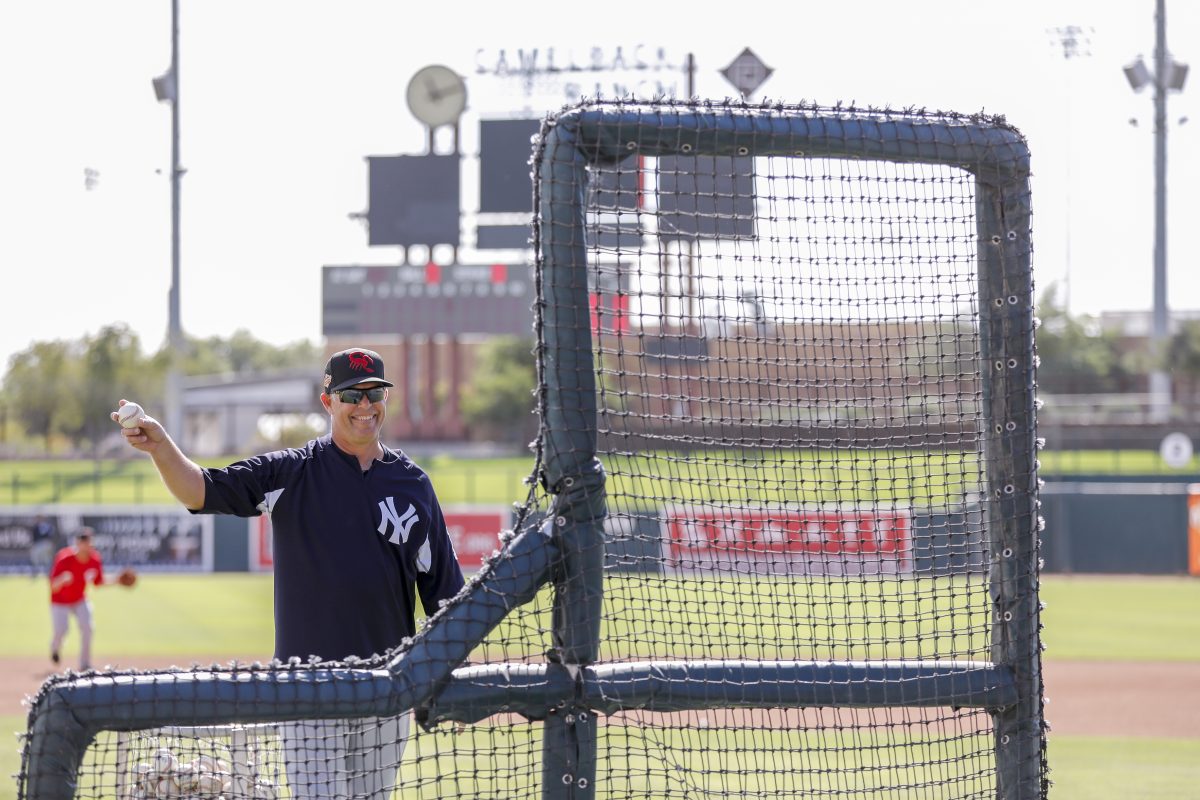
I had never met or spoken to Jay Bell before we had dinner together in Scottsdale after he managed the Scorpions in an Arizona Fall League game, but I knew he had a reputation for being a great guy. That was an understatement. We sat for hours, Jay a photographer and me, as he told us all his best stories of a life in baseball. It was transfixing, and I did the best I could at using the best ones in the feature.
I was interesting in writing about Bell once the Yankees named him the Tampa manager before the previous season. Bell, famously, scored the winning run against the Yankees in the 2001 World Series, a moment low down the list of franchise highlights. Obviously, people trade sides in baseball all the time, and it’s not like Bell is Curt Schilling after the 2004 ALCS or anything, but still, it was a fun quirk, and I thought it would make a good story. Then Bell proceeded to win Manager of the Year with Tampa, and he managed the Yankees’ prospects in the AFL (as well as those of a few other teams, including the Reds, who sent along Bell’s son, Brantley, which was a fun touch).
There was one particularly funny part of the dinner, though. Just a few days earlier, the Yankees had parted ways with manager Joe Girardi, and Bell’s name was among those listed as being on the list of candidates. We’d scheduled our dinner before that news broke, though, and part of me wondered if Bell would cancel on me due to any potential awkwardness.
Quite the opposite. In fact, I’m nearly positive he thought that I was sent by Brian Cashman as some kind of envoy, charged with reporting back all my observations. So many questions I asked, Bell answered with some variation of, “This is Cash’s team, and he does such a great job, and I just do whatever they tell me to do.” Deep down, I’m sure he didn’t really think that it was a job interview under the guise of a magazine feature, but I do wonder if he was being extra cautious just in case. Anyhow, my photographer and I shared a few laughs after the fact.
Seriously, though, Jay couldn’t have been nicer or more interesting. I love the stories I got to share here, and I hope you’ll read them and get as much joy as I did.